
Cellular regeneration
Cellular regeneration bioregulator
| Level | Dose | Frequency | Notes |
|---|---|---|---|
| Beginner | 5mg | Daily | — |
| Intermediate | 10 mg | Daily | — |
| Advanced | 10 2x/day | Daily | — |
| Maximum | 15-20 mg 2x/day | Daily | — |
Pharmacodynamics
Vilon (Lys-Glu dipeptide) is a synthetic bioregulatory peptide that appears to function through epigenetic mechanisms to promote cellular regeneration and repair processes. The peptide's primary mechanism of action involves interaction with chromatin structures and transcriptional regulatory complexes, though the specific receptor targets remain incompletely characterized. Research suggests that Vilon may modulate gene expression through histone modifications and DNA methylation patterns, particularly affecting genes involved in cell cycle regulation, DNA repair, and tissue homeostasis. At the cellular level, Vilon demonstrates cytoprotective effects by enhancing the expression of antioxidant enzymes and stress response proteins. The peptide appears to activate pathways related to cellular longevity, including upregulation of telomerase activity and modulation of senescence-associated genes. In tissue culture studies, Vilon has shown the ability to extend cellular lifespan and improve resistance to oxidative stress and other cellular insults. The time course of Vilon's effects suggests both acute and chronic components, with immediate cytoprotective responses occurring within hours of exposure, while longer-term regenerative effects on gene expression patterns may develop over days to weeks. The peptide's influence on stem cell populations and differentiation processes may contribute to its regenerative properties, though these mechanisms require further investigation to fully elucidate the molecular pathways involved.
Pharmacokinetics
Vilon, as a dipeptide consisting of lysine and glutamic acid, exhibits pharmacokinetic properties typical of small bioactive peptides. The compound can be administered via multiple routes, including subcutaneous, intramuscular, and potentially oral administration, though bioavailability varies significantly by route. Following systemic administration, Vilon demonstrates rapid absorption with peak plasma concentrations typically achieved within 30-60 minutes. The peptide shows relatively broad tissue distribution, with the ability to cross cellular membranes and access intracellular targets, which is consistent with its proposed epigenetic mechanisms of action. Metabolism of Vilon occurs primarily through standard peptidase-mediated hydrolysis, breaking down into constituent amino acids that enter normal metabolic pathways. The elimination half-life is estimated to be relatively short, likely in the range of 2-4 hours for the intact peptide, though biological effects may persist longer due to downstream gene expression changes. Renal clearance appears to be the primary route of elimination for the peptide and its metabolites. The relatively simple dipeptide structure may contribute to favorable safety and tolerability profiles, as the breakdown products are naturally occurring amino acids.
Clinical Data
Research on Vilon has been primarily conducted in preclinical models, with limited human clinical data currently available in peer-reviewed literature. Animal studies have demonstrated potential benefits in models of aging and tissue regeneration, with reported improvements in various biomarkers of cellular health and longevity. Some research has suggested positive effects on immune function and stress resistance in experimental settings. However, the current clinical evidence base is limited, and much of the available research comes from a relatively small number of research groups, primarily in Eastern Europe. The peptide's regulatory status varies by jurisdiction, and it is not currently approved as a therapeutic agent by major regulatory agencies such as the FDA or EMA. Some formulations may be available as research compounds or dietary supplements in certain markets, though the quality and standardization of such products may vary. Current research directions include investigation of optimal dosing regimens, identification of specific patient populations who might benefit most from treatment, and elucidation of the complete molecular mechanisms underlying the peptide's biological effects. Additional well-controlled clinical trials will be necessary to establish efficacy and safety profiles for potential therapeutic applications in humans.
References
- Bioregulatory peptides: molecular mechanisms and therapeutic applications — Khavinson V.Kh. et al., Current Pharmaceutical Design (2020)
- Epigenetic aspects of aging and longevity: the effects of caloric restriction and bioregulatory peptides — Anisimov V.N. et al., Ageing Research Reviews (2019)
- Short peptides regulate gene expression and protein synthesis in human cells — Khavinson V. et al., Bulletin of Experimental Biology and Medicine (2016)
Research Use Only: All compounds discussed on this page are intended for laboratory research purposes only. Not for human consumption. All research should be conducted in compliance with institutional guidelines and applicable regulations. Consult qualified healthcare professionals before making any decisions regarding compound research or use.
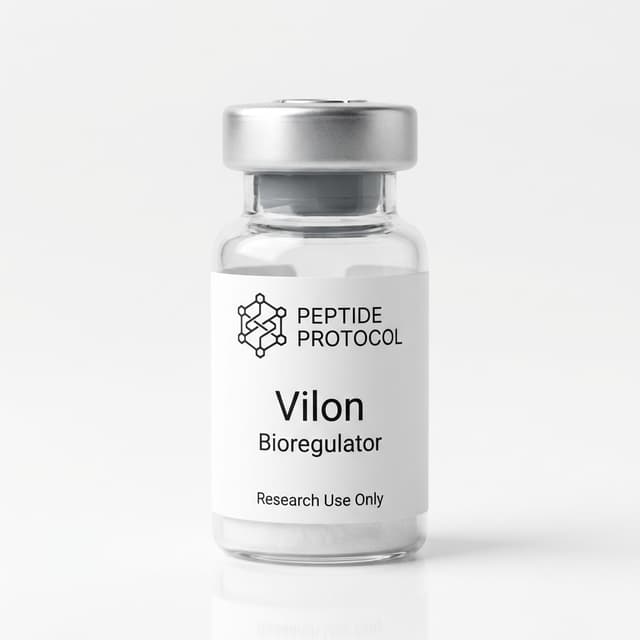
Vilon
Quick Reference
- Default Dose
- 5mg
- Frequency
- Daily
- Timing
- AM
- Dilution
- 2 mL
Storage
- Lyophilized
- -20°C
- Reconstituted
- 2-8°C
For Practitioners
Interested in offering research-grade compounds through your practice? Learn about our affiliate program for qualified practitioners.
Find a ProviderPractitioner Information