
High-intensity healing blend: TB-500 25mg + BPC-157 10mg + KPV 10mg
| Level | Dose | Frequency | Notes |
|---|---|---|---|
| Beginner | 2 mg 2x/week | 2-3x/week | — |
| Intermediate | 3 mg 2x/week | 2-3x/week | — |
| Advanced | 4 mg 3x/week | 2-3x/week | — |
| Maximum | 5mg 3x/week | 2-3x/week | — |
Blend Dosing Approach
Tri-Heal Max utilizes a **fixed-ratio blend format** where TB-500 (25mg), BPC-157 (10mg), and KPV (10mg) are pre-combined in each vial, eliminating the need for separate peptide preparation and calculations. This **pre-combined approach** simplifies administration by allowing users to focus on volume-based dosing rather than managing multiple peptide concentrations. Since the peptides are already mixed in optimal ratios, dosing becomes straightforward - the volume administered determines the amount of all three peptides proportionally. The **fixed concentrations** mean that dose adjustments are made by changing injection volume rather than altering individual peptide amounts. This approach assumes that the 25:10:10 mg ratio provides appropriate therapeutic levels for the intended synergistic effects. **Timing considerations** should account for the different pharmacokinetic profiles - while all three peptides have relatively short half-lives (2-8 hours), their biological effects may persist longer, potentially allowing for once or twice-daily administration depending on research protocols and individual response.
Per-Component Breakdown
Synergy Rationale
Tri-Heal Max combines three peptides with **complementary healing mechanisms** that address different aspects of the tissue repair cascade. TB-500 provides the **cellular migration foundation** by modulating actin dynamics, allowing repair cells to efficiently reach injury sites. BPC-157 contributes **systemic healing support** through enhanced angiogenesis and broad tissue repair capabilities, ensuring adequate blood flow and nutrient delivery to healing tissues. KPV adds crucial **anti-inflammatory modulation** through melanocortin pathway activation, creating an optimal healing environment by reducing destructive inflammation while preserving beneficial repair signals. This combination addresses the three critical phases of healing: **cellular mobilization** (TB-500), **vascular support and tissue regeneration** (BPC-157), and **inflammatory balance** (KPV). The rationale is that effective healing requires coordinated cellular movement, adequate blood supply, and properly regulated inflammation - deficiencies in any area can impede recovery. By combining peptides that target these distinct but interconnected pathways, Tri-Heal Max aims to provide comprehensive healing support rather than addressing isolated aspects of tissue repair.
Combined Mechanism
The combined mechanism of Tri-Heal Max creates a **multi-pathway healing cascade** where each peptide's actions support and potentially amplify the others' effects. TB-500's **actin modulation** facilitates cellular migration while also promoting **VEGF upregulation** for angiogenesis. BPC-157 works synergistically by independently stimulating **VEGF signaling** and **nitric oxide pathways**, potentially creating additive angiogenic effects that enhance blood flow to TB-500-mobilized repair cells. Both peptides influence **anti-inflammatory signaling**, with TB-500 reducing pro-inflammatory cytokines and BPC-157 modulating **TNF-α and IL-6** expression. KPV complements these effects through **melanocortin receptor activation**, which inhibits **NF-κB signaling** and promotes **IL-10 production**, creating a more controlled inflammatory environment that supports rather than hinders the repair processes initiated by TB-500 and BPC-157. The **temporal coordination** is particularly relevant - KPV's rapid anti-inflammatory effects (2-6 hours) can create favorable conditions for TB-500's cellular migration and BPC-157's tissue repair mechanisms. Additionally, all three peptides support **extracellular matrix remodeling** through different pathways, potentially improving healing quality and reducing excessive scar formation. This multi-target approach addresses healing comprehensively rather than through isolated mechanisms.
Research Context
Currently, **direct research on this specific three-peptide combination** is limited, as most peptide research focuses on individual compounds or simpler two-peptide combinations. The scientific rationale for Tri-Heal Max is based on **mechanistic compatibility** and complementary pathway interactions rather than dedicated combination studies. Individual research on TB-500, BPC-157, and KPV supports their **overlapping beneficial effects** in healing and inflammation modulation, suggesting potential for synergistic activity. Some research exists on **peptide combination approaches** in regenerative medicine, indicating that multi-target strategies can provide enhanced therapeutic outcomes compared to single-peptide treatments. However, this represents a **knowledge gap** where the theoretical synergy based on individual mechanisms requires validation through dedicated combination studies. Future research directions should focus on **pharmacokinetic interactions**, optimal ratio determination, and comparative efficacy studies between individual peptides and combination formulations. Users should understand that while the individual components have substantial research support, the **specific tri-peptide blend** represents an innovative approach that extends beyond current published research on this exact combination.
Research Use Only: All compounds discussed on this page are intended for laboratory research purposes only. Not for human consumption. All research should be conducted in compliance with institutional guidelines and applicable regulations. Consult qualified healthcare professionals before making any decisions regarding compound research or use.
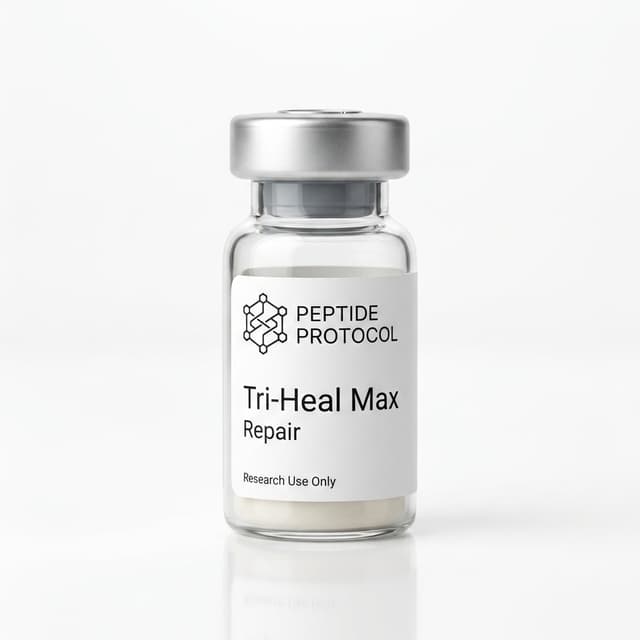
Tri-Heal Max
Quick Reference
- Default Dose
- 2 mg 2x/week
- Frequency
- 2-3x/week
- Timing
- —
- Dilution
- 1 Ml
For Practitioners
Interested in offering research-grade compounds through your practice? Learn about our affiliate program for qualified practitioners.
Find a ProviderPractitioner Information