
Immune + thymus regulation
Thymic hormone for immune regulation
| Level | Dose | Frequency | Notes |
|---|---|---|---|
| Beginner | 5 mg | Daily | — |
| Intermediate | 10 mg | Daily | — |
| Advanced | 10 2x/day | Daily | — |
| Maximum | 15-20 mg 2x/day | Daily | — |
Pharmacodynamics
Thymulin exerts its biological effects through a zinc-dependent mechanism that requires the peptide to form a stable complex with zinc ions for receptor binding and activation. The active thymulin-zinc complex interacts with specific receptors on thymocytes and peripheral immune cells, though the exact receptor structure remains under investigation. The primary mechanism involves binding to receptors on immature T-lymphocytes within the thymic cortex, where it acts as a differentiation signal promoting the maturation of CD4+ and CD8+ T-cell lineages. Upon receptor binding, thymulin activates intracellular signaling cascades involving cyclic adenosine monophosphate (cAMP) and protein kinase A pathways. This leads to transcriptional changes that enhance T-cell receptor expression and promote positive selection during thymic education. At the tissue level, thymulin modulates cytokine production by shifting the immune response from a pro-inflammatory Th1/Th17 profile toward a more balanced Th2 and regulatory T-cell response. The peptide suppresses the release of pro-inflammatory mediators including interleukin-1β, interleukin-6, tumor necrosis factor-alpha, and interferon-gamma, while simultaneously increasing anti-inflammatory interleukin-10 production. The time course of thymulin effects appears biphasic, with immediate receptor-mediated responses occurring within minutes to hours, followed by longer-term transcriptional effects that manifest over 24-72 hours. The zinc-dependency is critical, as zinc-depleted thymulin shows minimal biological activity, highlighting the importance of adequate zinc status for optimal immune function.
Pharmacokinetics
Thymulin administration typically occurs via subcutaneous or intramuscular injection, as the peptide's nonapeptide structure makes it susceptible to gastrointestinal degradation, limiting oral bioavailability. Following parenteral administration, thymulin demonstrates rapid absorption with peak plasma concentrations achieved within 15-30 minutes. The peptide shows preferential distribution to lymphoid tissues, particularly the thymus, spleen, and lymph nodes, with moderate protein binding primarily to albumin and zinc-transport proteins. Tissue penetration appears to be enhanced by the peptide's small molecular size and hydrophilic properties, allowing effective access to target immune cell populations. Metabolism occurs primarily through enzymatic degradation by peptidases and aminopeptidases in the liver and kidneys, following typical pathways for small peptide hormones. The elimination half-life is relatively short, estimated at 1-2 hours based on structural similarities to other nonapeptide hormones, necessitating frequent dosing or sustained-release formulations for therapeutic applications. Renal clearance represents the primary elimination route for both intact thymulin and its metabolic fragments. The zinc component is recycled through normal zinc homeostatic mechanisms involving metallothionein binding and redistribution to zinc-dependent enzymes.
Clinical Data
Preclinical research in animal models has demonstrated thymulin's immunomodulatory effects across multiple species. Studies in aged mice showed that thymulin administration restored age-related decline in T-cell function and improved immune responses to vaccination. Research in rodent models of autoimmune conditions indicated that thymulin treatment reduced inflammatory markers and tissue damage. Limited human studies have primarily focused on thymulin levels as biomarkers of immune aging and thymic function, with observational data showing decreased circulating thymulin concentrations in elderly individuals and patients with immunodeficiency states. Small clinical trials in the 1980s and 1990s investigated thymulin supplementation in immunocompromised patients, reporting improvements in T-cell counts and reduced infection rates, though these studies had methodological limitations by current standards. The peptide is not currently approved as a therapeutic agent by major regulatory agencies including the FDA or EMA, and remains classified as an investigational compound. Current research directions include development of more stable thymulin analogs, investigation of combination therapies with zinc supplementation, and exploration of applications in age-related immune decline. Recent interest has emerged in thymulin's potential role in COVID-19 recovery and long-COVID syndrome management, though this remains highly preliminary and requires rigorous clinical validation.
References
- Thymulin (facteur thymique serique) and zinc contents of the thymus glands of malnourished children — Prasad AS et al., American Journal of Clinical Nutrition (1988)PubMed
- The zinc-dependent tuftsin-like immunostimulating hormone thymulin: biological properties and clinical applications — Dardenne M et al., Medical Hypotheses (1982)PubMed
- Thymulin and its role in immunosenescence — Mocchegiani E et al., Neuroimmunomodulation (1998)PubMed
- Age-related changes in thymulin secretion by human thymic epithelial cells — Savino W et al., Clinical and Experimental Immunology (1993)PubMed
Research Use Only: All compounds discussed on this page are intended for laboratory research purposes only. Not for human consumption. All research should be conducted in compliance with institutional guidelines and applicable regulations. Consult qualified healthcare professionals before making any decisions regarding compound research or use.
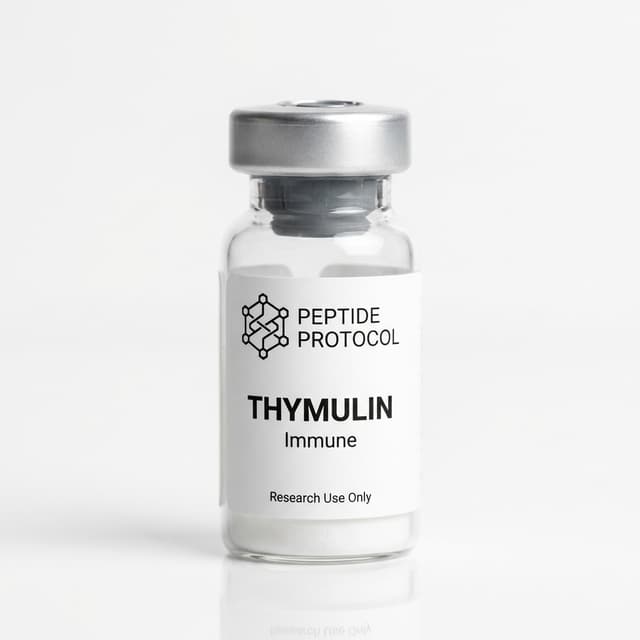
Thymulin
Quick Reference
- Default Dose
- 5 mg
- Frequency
- Daily
- Timing
- AM
- Dilution
- 2 mL
Storage
- Lyophilized
- -20°C
- Reconstituted
- 2-8°C
For Practitioners
Interested in offering research-grade compounds through your practice? Learn about our affiliate program for qualified practitioners.
Find a ProviderPractitioner Information