
Actin modulation, healing
Thymosin Beta-4 fragment for healing and recovery
| Level | Dose | Frequency | Notes |
|---|---|---|---|
| Beginner | 500 mcg | 2-3x/week | — |
| Intermediate | 1-2 mg | 2-3x/week | — |
| Advanced | 3-5 mg | 2-3x/week | — |
| Maximum | 5-7mg | 2-3x/week | — |
Pharmacodynamics
Thymosin beta-4 exerts its biological effects primarily through direct interaction with globular actin (G-actin), the monomeric building blocks of actin filaments. The peptide binds to G-actin in a 1:1 stoichiometric ratio, sequestering actin monomers and preventing their incorporation into filamentous actin (F-actin) structures. This mechanism maintains a readily available pool of actin monomers that can be rapidly mobilized during cellular remodeling processes. Beyond actin sequestration, thymosin beta-4 activates several downstream signaling cascades that promote tissue repair. The peptide stimulates endothelial cell migration and proliferation through upregulation of vascular endothelial growth factor (VEGF) and angiopoietin-1 pathways, leading to enhanced angiogenesis. It also modulates inflammatory responses by promoting the transition from pro-inflammatory M1 macrophages to anti-inflammatory M2 phenotypes, creating a more favorable healing environment. At the cellular level, thymosin beta-4 promotes keratinocyte and fibroblast migration through lamellipodial extension and enhanced cell motility. The peptide also exhibits anti-apoptotic properties by activating survival pathways including Akt/PI3K signaling, which helps preserve viable tissue in injury models. The temporal effects typically manifest within hours of administration, with peak cellular migration responses observed 12-24 hours post-treatment. Tissue-level effects, including neovascularization and wound closure, generally become apparent within 3-7 days, reflecting the coordinated cellular processes underlying tissue regeneration.
Pharmacokinetics
Thymosin beta-4 demonstrates favorable pharmacokinetic properties for therapeutic applications, though comprehensive human ADME data remains limited. The peptide can be administered via subcutaneous, intramuscular, or intravenous routes, with subcutaneous injection being most commonly studied due to improved patient compliance and sustained local effects. Following subcutaneous administration, the peptide exhibits relatively rapid absorption with detectable plasma levels within 30 minutes. Distribution studies indicate thymosin beta-4 readily penetrates various tissues, with particular accumulation observed in injured or inflamed areas, suggesting preferential targeting to sites requiring repair. The peptide demonstrates minimal plasma protein binding, allowing for efficient tissue penetration and cellular uptake. Metabolism occurs primarily through enzymatic degradation by peptidases and proteases, following typical pathways for bioactive peptides. The elimination half-life in rodent models ranges from 1-4 hours depending on the route of administration, with subcutaneous injection generally providing more sustained exposure than intravenous delivery. Renal elimination appears to be a significant clearance mechanism, though hepatic metabolism also contributes to overall clearance. The relatively short half-life necessitates repeated dosing protocols in research studies, typically ranging from daily to every few days depending on the specific application and desired therapeutic outcomes.
Clinical Data
Preclinical research on thymosin beta-4 has demonstrated promising results across multiple animal models of tissue injury and disease. In cardiac research, studies using myocardial infarction models in mice and rats have shown that thymosin beta-4 treatment can improve cardiac function, reduce infarct size, and promote cardiomyocyte survival. Wound healing studies in various animal models, including diabetic mice and pressure ulcer models, have consistently demonstrated accelerated wound closure, improved tissue quality, and enhanced angiogenesis following thymosin beta-4 treatment. Musculoskeletal research has shown potential benefits in tendon injury models, with improved healing characteristics and reduced scarring observed in treated animals. Currently, thymosin beta-4 and its derivatives are classified as investigational compounds, with no approved therapeutic indications from major regulatory agencies. Clinical development has been limited, with most human studies focused on safety evaluation rather than efficacy endpoints. Some small-scale clinical trials have been conducted for wound healing applications, though comprehensive efficacy data remains limited. Current research directions include development of modified peptide analogs with improved pharmacokinetic properties, combination therapies with other regenerative agents, and exploration of novel delivery systems to enhance therapeutic outcomes. The regulatory pathway forward likely requires larger, well-controlled clinical studies to establish safety and efficacy profiles for specific therapeutic applications.
References
- Thymosin beta4 promotes dermal wound repair and regeneration — Philp D et al., Annals of the New York Academy of Sciences (2007)DOIPubMed
- Thymosin β4 is essential for coronary vessel development and promotes neovascularization via adult vasculogenesis — Smart N et al., Proceedings of the National Academy of Sciences (2007)DOIPubMed
- Thymosin beta-4 accelerates wound healing — Malinda KM et al., Journal of Investigative Dermatology (1999)DOIPubMed
- The small molecular weight G-actin sequestering peptide thymosin β4 promotes tissue repair through multifunctional mechanisms — Crockford D et al., Annals of the New York Academy of Sciences (2010)DOIPubMed
Research Use Only: All compounds discussed on this page are intended for laboratory research purposes only. Not for human consumption. All research should be conducted in compliance with institutional guidelines and applicable regulations. Consult qualified healthcare professionals before making any decisions regarding compound research or use.
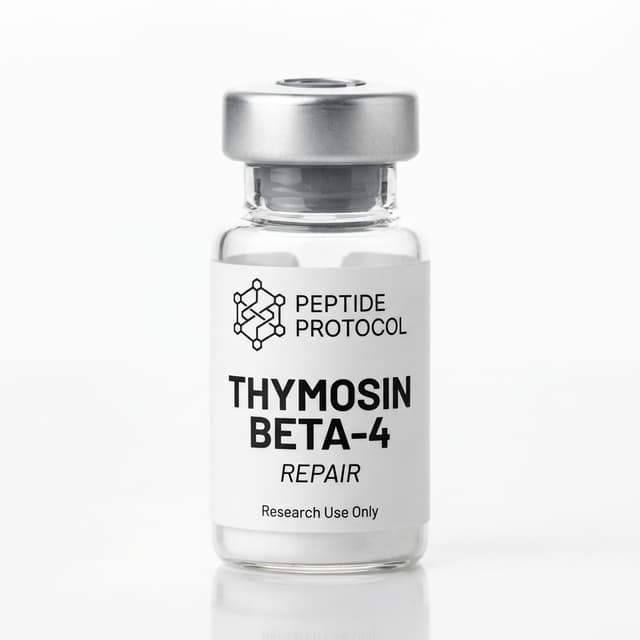
Thymosin Beta-4
Quick Reference
- Default Dose
- 500 mcg
- Frequency
- 2-3x/week
- Timing
- Any
- Dilution
- 2 mL
Storage
- Lyophilized
- -20°C
- Reconstituted
- 2-8°C
For Practitioners
Interested in offering research-grade compounds through your practice? Learn about our affiliate program for qualified practitioners.
Find a ProviderPractitioner Information