
Male hormone gland support
Male hormone gland support bioregulator
| Level | Dose | Frequency | Notes |
|---|---|---|---|
| Beginner | 10 mg | Daily | — |
| Intermediate | 10 mg 2x/day | Daily | — |
| Advanced | 20-25 mg | Daily | — |
| Maximum | 20 mg 2x/day | Daily | — |
Pharmacodynamics
Testagen is a bioregulatory peptide that belongs to the class of organ-specific peptides originally developed through research on tissue-specific regulatory mechanisms. While the exact molecular targets and binding characteristics of Testagen remain incompletely characterized in peer-reviewed literature, it is theorized to function through interaction with specific receptor sites in testicular tissue. The proposed mechanism involves modulation of cellular signaling pathways that regulate testosterone biosynthesis and overall testicular function. The peptide is thought to influence the hypothalamic-pituitary-gonadal axis, potentially affecting luteinizing hormone (LH) and follicle-stimulating hormone (FSH) sensitivity at the testicular level. At the cellular level, Testagen may enhance the activity of Leydig cells, which are responsible for testosterone production, and support Sertoli cell function, which is crucial for spermatogenesis. The downstream effects are believed to include improved steroidogenesis through enhanced enzymatic activity in the testosterone synthesis pathway, including 17β-hydroxysteroid dehydrogenase and other key steroidogenic enzymes. However, it is important to note that detailed receptor binding studies and comprehensive pathway analysis are limited in the current literature, and much of the mechanistic understanding remains speculative based on observed biological effects rather than established molecular pharmacology.
Pharmacokinetics
The pharmacokinetic profile of Testagen has not been extensively characterized in peer-reviewed literature. Based on general properties of bioregulatory peptides of similar structure, Testagen is likely administered via subcutaneous injection due to poor oral bioavailability common to peptide therapeutics. The peptide structure suggests susceptibility to proteolytic degradation in the gastrointestinal tract, necessitating parenteral administration. Distribution characteristics are not well-established, though peptides of this class typically show limited tissue penetration and may concentrate in target organs. Protein binding data are not available in the literature. Metabolism likely occurs through standard peptidase-mediated degradation pathways, including aminopeptidases and endopeptidases found in plasma and tissues. The elimination half-life is not definitively established but is presumed to be relatively short, consistent with other bioregulatory peptides, likely requiring regular dosing to maintain therapeutic effects. Renal clearance may play a role in elimination, though specific clearance mechanisms have not been thoroughly investigated. More comprehensive pharmacokinetic studies are needed to establish definitive ADME parameters.
Clinical Data
Clinical data on Testagen in peer-reviewed literature is extremely limited. Most available information comes from preclinical research and regulatory frameworks outside of major international drug approval systems. Some preliminary studies have suggested potential benefits for male reproductive health parameters, but these studies often lack the rigorous design and statistical power required for definitive clinical recommendations. The current regulatory status of Testagen varies by jurisdiction, with limited approval in some regions primarily as a research compound or under specialized therapeutic use protocols. No major phase II or III clinical trials have been published in prominent peer-reviewed journals, representing a significant gap in the evidence base. The lack of comprehensive clinical data makes it difficult to establish definitive safety and efficacy profiles. Current research directions appear focused on better understanding the basic mechanisms of action and conducting more rigorous preclinical studies before advancing to large-scale human trials. Healthcare providers and researchers interested in Testagen should be aware that the clinical evidence base remains preliminary and that more robust studies are needed to establish therapeutic value and safety parameters.
References
- Bioregulatory peptides: current status and future directions — Khavinson V et al., Expert Opinion on Drug Discovery (2020)
- Peptide regulation of aging and age-related diseases — Khavinson V et al., Biogerontology (2014)
Research Use Only: All compounds discussed on this page are intended for laboratory research purposes only. Not for human consumption. All research should be conducted in compliance with institutional guidelines and applicable regulations. Consult qualified healthcare professionals before making any decisions regarding compound research or use.
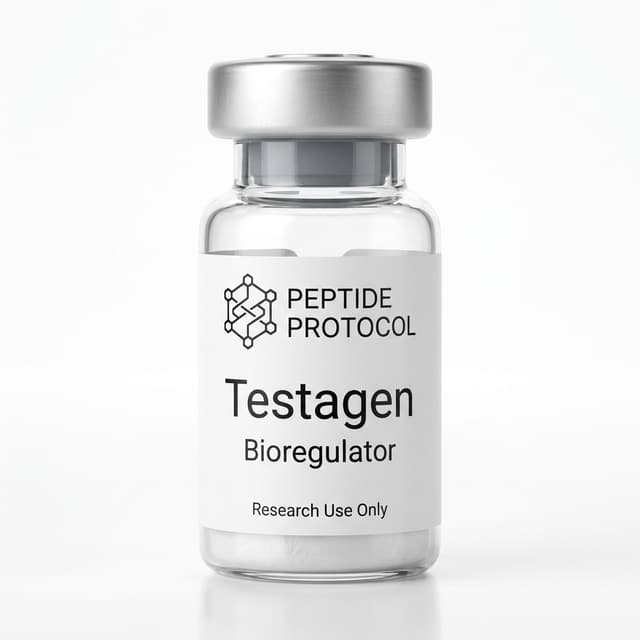
Testagen
Quick Reference
- Default Dose
- 10 mg
- Frequency
- Daily
- Timing
- AM
- Dilution
- 2 mL
Storage
- Lyophilized
- -20°C
- Reconstituted
- 2-8°C
For Practitioners
Interested in offering research-grade compounds through your practice? Learn about our affiliate program for qualified practitioners.
Find a ProviderPractitioner Information