
Premium GH blend for visceral fat loss
| Level | Dose | Frequency | Notes |
|---|---|---|---|
| Beginner | 1 mg | 5 days on, 2 off | — |
| Intermediate | 2.6 mg | 5 days on, 2 off | — |
| Advanced | 3 mg | 5 days on, 2 off | — |
| Maximum | 2 mg 2x/day | 5 days on, 2 off | — |
Blend Dosing Approach
This product is supplied as a **pre-combined, fixed-ratio blend** of Tesamorelin and Ipamorelin, meaning both peptides are present in a single reconstituted vial at predetermined concentrations. This format eliminates the need to manage separate vials, individual reconstitutions, or sequential injections, simplifying the administration process considerably. Because concentrations are fixed, **dosing is volume-based** — the amount of blend drawn per injection determines the quantity of both peptides delivered simultaneously. Subcutaneous injection is the appropriate route for this blend, consistent with the pharmacokinetic requirements of both components. Timing considerations are relevant: both peptides demonstrate **peak GH effects within 30-60 minutes post-injection**, and administration in a fasted state or away from large meals may support optimal receptor responsiveness. Once-daily or twice-daily dosing frequency reflects the complementary half-lives and effect durations of the two components.
Per-Component Breakdown
Synergy Rationale
The combination of **Tesamorelin** and **Ipamorelin** represents a strategic dual-axis approach to **growth hormone axis stimulation**, targeting two distinct but convergent receptor systems simultaneously. Tesamorelin acts as a **GHRH analog**, binding to **GHRH receptors** on pituitary somatotrophs and stimulating GH release through **cAMP-dependent signaling**. Ipamorelin, by contrast, activates the **ghrelin receptor (GHSR-1a)** through a separate **Gq/11 calcium-dependent pathway**. Because these two peptides engage different receptor systems that both culminate in **growth hormone secretion**, their combination is designed to produce an amplified, complementary GH release signal that neither compound achieves alone. This dual-receptor engagement mirrors the body's own physiological co-regulation of GH secretion, where both GHRH and ghrelin-like signals work in concert. The addition of ipamorelin's **pulsatile GH stimulus** complements tesamorelin's sustained IGF-1 elevation, creating a broader metabolic profile particularly oriented toward **visceral fat reduction** and **lean mass preservation**.
Combined Mechanism
At the pathway level, tesamorelin and ipamorelin approach **GH secretion** through mechanistically distinct but synergistic routes. Tesamorelin engages **GHRH receptors** coupled to **Gs proteins**, activating **adenylyl cyclase** to elevate **cyclic AMP (cAMP)** and stimulate **protein kinase A (PKA)**. This drives transcription and exocytosis of stored GH in a manner that reflects the body's natural circadian pulsatility. Ipamorelin simultaneously binds **GHSR-1a receptors** coupled primarily to **Gq/11 proteins**, activating **phospholipase C**, generating **IP3 and DAG**, and mobilizing **intracellular calcium** to trigger a distinct but parallel exocytotic GH release event. The co-activation of both **cAMP/PKA** and **calcium/PKC** pathways within pituitary somatotrophs is understood to produce a greater GH pulse amplitude than either signal alone — a mechanism well-documented with GHRH and ghrelin co-administration in physiological research. The resulting elevated **GH output** drives hepatic **IGF-1 production**, which then activates **PI3K/Akt** and **mTOR signaling** in peripheral tissues, promoting **lipolysis in visceral adipose tissue** and **protein synthesis in skeletal muscle**. Tesamorelin's established capacity for **selective visceral fat reduction** is therefore supported by ipamorelin's amplification of the upstream GH stimulus. Importantly, ipamorelin's **receptor selectivity** means this amplification occurs without meaningfully elevating **cortisol or prolactin**, preserving the metabolic cleanliness of the combined signal and reducing the risk of counterproductive hormonal interference.
Research Context
Direct clinical research on the **Tesamorelin/Ipamorelin combination specifically** is currently limited, and no published controlled trials have evaluated this precise pairing in human subjects. However, the scientific rationale for combining a **GHRH analog** with a **growth hormone secretagogue (GHS)** is well-supported by foundational endocrinology research. Studies examining **GHRH plus ghrelin** or **GHRH plus GHRP co-administration** consistently demonstrate that dual-pathway stimulation produces greater GH pulse amplitude than either agent alone — the mechanistic basis upon which this blend is formulated. Tesamorelin itself has robust Phase III human clinical data supporting its efficacy in **visceral fat reduction**, while ipamorelin's human data remains limited to early pharmacokinetic and acute GH-response studies. Consumers should understand that while the individual component science is credible, the **synergistic effects of this specific combination** in humans have not been formally evaluated in long-term trials. This blend is positioned as a **research formulation**, and its use should be understood within that context.
Research Use Only: All compounds discussed on this page are intended for laboratory research purposes only. Not for human consumption. All research should be conducted in compliance with institutional guidelines and applicable regulations. Consult qualified healthcare professionals before making any decisions regarding compound research or use.
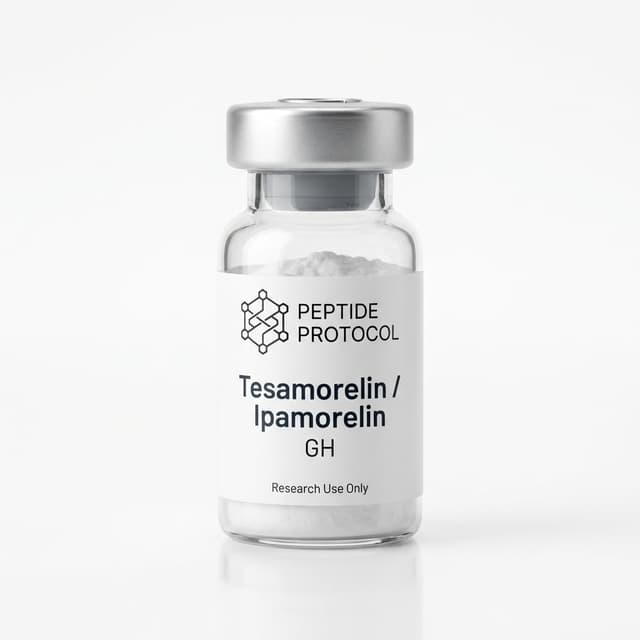
Tesamorelin / Ipamorelin
Quick Reference
- Default Dose
- 1 mg
- Frequency
- 5 days on, 2 off
- Timing
- —
- Dilution
- 1 mL
For Practitioners
Interested in offering research-grade compounds through your practice? Learn about our affiliate program for qualified practitioners.
Find a ProviderPractitioner Information