
IGF-1 increase, visceral fat loss
GHRH analog for visceral fat reduction
| Level | Dose | Frequency | Notes |
|---|---|---|---|
| Beginner | 1 mg | Daily | Target is 2mg |
| Intermediate | 2 mg | 5 days on, 2 off | — |
| Advanced | 1.5 mg 2x/day | 5 days on, 2 off | — |
| Maximum | 2 mg 2x/day | Twice daily | AM/PM |
Pharmacodynamics
Tesamorelin functions as a synthetic analog of growth hormone-releasing hormone (GHRH), binding with high affinity to GHRH receptors located on anterior pituitary somatotrophs. Upon receptor binding, tesamorelin activates adenylyl cyclase through G-protein coupled signaling, leading to increased cyclic adenosine monophosphate (cAMP) levels and subsequent protein kinase A activation. This cascade stimulates the transcription and release of endogenous growth hormone (GH) in physiological pulsatile patterns, preserving the natural circadian rhythm of GH secretion. The released GH then binds to GH receptors in peripheral tissues, particularly the liver, stimulating the production and secretion of insulin-like growth factor-1 (IGF-1) and its binding protein IGFBP-3. IGF-1 mediates many of the metabolic effects through binding to IGF-1 receptors, activating downstream PI3K/Akt and MAPK signaling pathways. In adipose tissue, this signaling enhances lipolysis through activation of hormone-sensitive lipase and adipose triglyceride lipase, preferentially targeting visceral fat deposits. The mechanism shows tissue selectivity, with visceral adipocytes demonstrating greater responsiveness to GH/IGF-1 signaling compared to subcutaneous fat. In skeletal muscle, IGF-1 promotes protein synthesis and inhibits protein degradation through mTOR pathway activation. The time course typically shows GH elevation within 30-60 minutes post-administration, with IGF-1 levels peaking 3-4 hours later and remaining elevated for 12-24 hours, supporting once-daily dosing regimens.
Pharmacokinetics
Tesamorelin is administered via subcutaneous injection, as oral bioavailability is negligible due to peptide degradation by gastrointestinal proteases. Following subcutaneous administration, the peptide demonstrates rapid absorption with peak plasma concentrations achieved within 15-30 minutes. The bioavailability via subcutaneous route is approximately 70-80% compared to intravenous administration. Distribution is primarily limited to extracellular fluid compartments due to the peptide's hydrophilic nature and molecular size, with minimal tissue penetration beyond the injection site. Protein binding appears to be low to moderate, allowing for adequate free drug availability. Metabolism occurs primarily through enzymatic cleavage by peptidases and proteases, particularly dipeptidyl peptidase-4 (DPP-4) and neutral endopeptidases, which cleave the peptide at specific amino acid sequences. The primary site of metabolism is hepatic, though extrahepatic tissues also contribute to degradation. Elimination follows first-order kinetics with a plasma half-life of approximately 26-38 minutes for the parent compound. However, the pharmacodynamic effects persist significantly longer than the plasma half-life would suggest, with GH elevation lasting 2-4 hours and IGF-1 increases sustained for 12-24 hours post-dose. Renal elimination of intact peptide is minimal, with metabolites primarily cleared through normal protein catabolism pathways.
Clinical Data
Preclinical studies in animal models demonstrated tesamorelin's ability to stimulate endogenous GH release and reduce visceral adiposity without significant effects on subcutaneous fat. Pivotal human clinical trials were conducted primarily in HIV-positive patients with lipodystrophy-associated visceral adipose accumulation. The largest Phase III studies showed significant reductions in visceral adipose tissue (VAT) measured by CT scan, with mean decreases of 15-18% compared to placebo over 26 weeks of treatment. These studies also demonstrated improvements in triglyceride levels and maintenance of lean body mass. Tesamorelin received FDA approval in 2010 specifically for the reduction of excess abdominal fat in HIV patients with lipodystrophy, representing the first approved therapy for this indication. Post-marketing studies have continued to evaluate long-term safety and efficacy, with some research exploring applications beyond HIV lipodystrophy, including age-related visceral adiposity and metabolic syndrome. Current regulatory status remains limited to the HIV lipodystrophy indication, though ongoing research is investigating broader metabolic applications. Safety monitoring has focused on glucose metabolism effects, as GH elevation can induce insulin resistance in some patients. The clinical development program established clear efficacy in visceral fat reduction while highlighting the importance of glucose monitoring during treatment. Ongoing research directions include combination therapies and potential applications in non-HIV populations with visceral adiposity.
References
- Effects of tesamorelin on body composition and metabolic parameters in HIV-infected patients with abdominal fat accumulation: a randomized placebo-controlled trial — Falutz J et al., AIDS (2010)DOIPubMed
- Long-term safety and effects of tesamorelin, a growth hormone-releasing factor analogue, in HIV patients with abdominal fat accumulation — Falutz J et al., AIDS (2013)DOIPubMed
- Tesamorelin reduces visceral fat in HIV-infected patients with abdominal fat accumulation: a randomized multicenter trial — Stanley TL et al., Annals of Internal Medicine (2010)DOIPubMed
- Growth hormone-releasing hormone receptor antagonists — Schally AV et al., Proceedings of the National Academy of Sciences (2001)DOIPubMed
Research Use Only: All compounds discussed on this page are intended for laboratory research purposes only. Not for human consumption. All research should be conducted in compliance with institutional guidelines and applicable regulations. Consult qualified healthcare professionals before making any decisions regarding compound research or use.
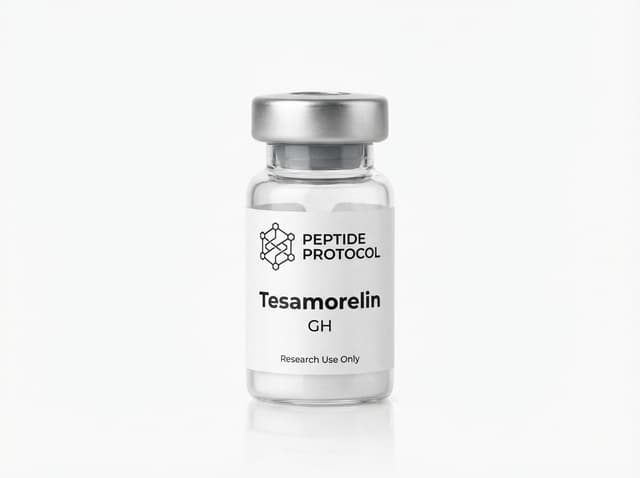
Tesamorelin
Quick Reference
- Default Dose
- 1 mg
- Frequency
- Daily
- Timing
- PM
- Dilution
- 2 mL
Storage
- Lyophilized
- -20°C
- Reconstituted
- 2-8°C
For Practitioners
Interested in offering research-grade compounds through your practice? Learn about our affiliate program for qualified practitioners.
Find a ProviderPractitioner Information