
Cardiomyocyte/mito repair
Mitochondrial-targeted peptide for cellular repair
Research Background
SS-31—better known in the clinical literature as Elamipretide—is a mitochondria-targeted tetrapeptide built around a simple but high-leverage idea: stabilize the inner mitochondrial membrane so the electron transport chain can run cleaner. The inner membrane is packed with Cardiolipin, a unique phospholipid that helps organize respiratory chain “supercomplexes” and membrane curvature. SS-31 is an aromatic-cationic peptide that concentrates at the inner membrane and interacts with cardiolipin-rich lipid bilayers, changing membrane surface electrostatics and supporting structural organization—i.e., it’s less “turn on mitochondria” and more “fix the wiring and insulation.” That membrane-first mechanism is why papers consistently frame SS-31 as improving coupling efficiency, lowering pathological reactive oxygen species (ROS), and improving respiratory performance in stressed systems, rather than acting like a classic metabolic stimulant. Preclinically, the SS-31 thesis has been tested across multiple “mitochondria-broken” scenarios (ischemia-reperfusion injury, heart failure models, muscle dysfunction, and genetic cardiolipin disorders). In animal and mechanistic studies, investigators report reduced mitochondrial ROS, improved membrane potential, improved respiration, and improved ATP output—all consistent with a drug whose edge is membrane stabilization and electron transport efficiency. A particularly relevant disease model is Barth syndrome, where cardiolipin remodeling is impaired (TAZ/tafazzin pathway). In tafazzin-deficient models, SS-31 has been shown to ameliorate mitochondrial dysfunction and improve cardiac-mitochondrial measures—exactly the “cardiolipin adjacency” story it was designed for. Clinically, the story is more nuanced—useful, but not a victory lap. In primary mitochondrial myopathy, a high-quality randomized trial reported no improvement in key functional endpoints (e.g., 6-minute walk test, fatigue) at 24 weeks versus placebo, which is basically the market telling the science: “mechanism is plausible, outcomes are hard.” In Barth syndrome, trials and follow-on/longer-term reports have suggested tolerability and signals across functional and cardiac assessments, but the dataset is constrained by ultra-rare disease realities (small n, endpoint selection, heterogeneity). The net: SS-31 has real biology, but translating that biology into hard functional endpoints is the make-or-break gap—especially when regulators want outcomes, not vibes. On the regulatory/market side, U.S. Food and Drug Administration decisions around elamipretide have been high-profile precisely because the unmet need is massive and the evidence package has been debated. Reporting in late 2025 described FDA clearance for a Barth syndrome product (Forzinity) amid internal reviewer objections on efficacy—highlighting the classic tension in rare disease drug development: statistical purity vs. clinical urgency.
| Level | Dose | Frequency | Notes |
|---|---|---|---|
| Beginner | 3 mg | 5x/week | — |
| Intermediate | 5 mg | 5x/week | — |
| Advanced | 10 mg | 5x/week | — |
| Maximum | 15 mg | 5x/week | — |
Pharmacodynamics
SS-31 (also known as Elamipretide or MTP-131) is a mitochondria-targeting peptide that selectively binds to cardiolipin, a unique phospholipid found exclusively in the inner mitochondrial membrane. The peptide contains an alternating cationic-aromatic amino acid sequence (D-Arg-dimethylTyr-Lys-Phe-NH2) that enables it to cross cellular and mitochondrial membranes and specifically associate with cardiolipin through electrostatic and hydrophobic interactions. Once bound to cardiolipin, SS-31 stabilizes the lipid's molecular structure and prevents its peroxidation, which is critical for maintaining optimal mitochondrial cristae architecture and respiratory chain supercomplex formation. The peptide's primary mechanism involves stabilizing Complex III and Complex IV of the electron transport chain, reducing electron leak and subsequent reactive oxygen species (ROS) generation. This leads to improved ATP synthesis efficiency and reduced oxidative stress within cardiomyocytes. SS-31 also helps maintain cytochrome c association with the inner membrane, preventing its release into the cytoplasm and subsequent apoptotic signaling. At the cellular level, these effects translate to improved mitochondrial bioenergetics, reduced cell death, and enhanced cellular resilience under stress conditions. The time course of SS-31 effects appears to be relatively rapid, with mitochondrial respiratory improvements observed within hours of treatment in preclinical models, while structural improvements in mitochondrial cristae may require longer exposure periods.
Pharmacokinetics
SS-31 demonstrates favorable pharmacokinetic properties for therapeutic applications, with multiple administration routes showing efficacy in preclinical studies. The peptide can be administered intravenously, subcutaneously, or orally, though bioavailability varies significantly by route. Following intravenous administration, SS-31 exhibits rapid tissue distribution with preferential accumulation in metabolically active organs, particularly the heart, brain, and kidneys, due to their high mitochondrial density. The peptide's unique chemical structure, featuring D-amino acids and dimethylated tyrosine, provides resistance to proteolytic degradation, extending its half-life compared to natural peptides. Plasma protein binding appears to be minimal, facilitating tissue penetration. The peptide crosses both the blood-brain barrier and cellular membranes efficiently due to its cell-penetrating properties. Metabolism occurs primarily through peptidase activity in tissues, with the liver playing a significant role in clearance. Elimination half-life varies depending on the study model but generally ranges from 1-4 hours in small animal models. Renal excretion contributes to elimination, with both unchanged peptide and metabolites detected in urine. The peptide's mitochondrial accumulation properties result in prolonged residence time within target organelles, potentially extending pharmacological effects beyond plasma clearance.
Clinical Data
Preclinical studies with SS-31 have demonstrated significant cardioprotective effects across multiple animal models of cardiac injury. In rodent models of myocardial infarction, SS-31 treatment reduced infarct size, improved left ventricular function, and decreased markers of oxidative stress and inflammation. Studies in aged animals showed that SS-31 could reverse age-related mitochondrial dysfunction and improve cardiac performance. The peptide has also shown efficacy in models of diabetic cardiomyopathy, reducing mitochondrial damage and improving metabolic function. Clinical development of SS-31 (Elamipretide) has progressed through Phase I and Phase II trials, primarily focusing on mitochondrial diseases and heart failure conditions. Early clinical studies demonstrated acceptable safety profiles with mild injection site reactions being the most common adverse event. Phase II trials in patients with mitochondrial myopathy showed improvements in exercise capacity and quality of life measures. However, some larger Phase III trials in heart failure with preserved ejection fraction did not meet primary endpoints, leading to program modifications. Currently, research continues into optimal patient populations, dosing regimens, and combination therapies. The peptide has received orphan drug designation for certain mitochondrial diseases, and ongoing studies are exploring its potential in acute cardiac conditions and age-related cardiovascular decline.
References
- Cardiolipin-altering agents and mitochondrial dysfunction in aged hearts — Dai DF et al., Journal of Molecular and Cellular Cardiology (2014)
- A mitochondria-targeted peptide reverses ATP synthase dysfunction and reduces ischemia-reperfusion injury in hearts from type 2 diabetic mice — Chavez JD et al., Cardiovascular Research (2017)
- SS-31, a small molecule antioxidant, improves cardiac and vascular responses to acute pressure overload — Kloner RA et al., European Journal of Heart Failure (2012)
- Mitochondria-targeted peptide MTP-131 alleviates mitochondrial dysfunction and oxidative damage in human trabecular meshwork cells — Steele ML et al., Investigative Ophthalmology & Visual Science (2013)
Research Use Only: All compounds discussed on this page are intended for laboratory research purposes only. Not for human consumption. All research should be conducted in compliance with institutional guidelines and applicable regulations. Consult qualified healthcare professionals before making any decisions regarding compound research or use.
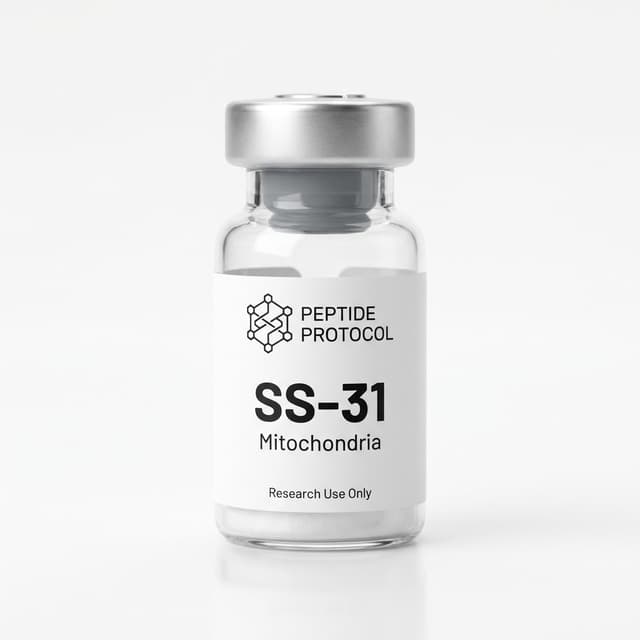
SS-31
Quick Reference
- Default Dose
- 3 mg
- Frequency
- 5x/week
- Timing
- AM
- Dilution
- 1 mL
Storage
- Lyophilized
- -20°C
- Reconstituted
- 2-8°C
For Practitioners
Interested in offering research-grade compounds through your practice? Learn about our affiliate program for qualified practitioners.
Find a ProviderPractitioner Information