
Muscle relaxation peptide
Muscle relaxation peptide
| Level | Dose | Frequency | Notes |
|---|---|---|---|
| Beginner | Topical Spray | Daily | — |
| Intermediate | Topical Spray | Daily | — |
| Advanced | Topical Spray | Daily | — |
| Maximum | Topical Spray | Daily | — |
Pharmacodynamics
SNAP-8 (Acetyl Glutamyl Heptapeptide-3) is a synthetic octapeptide that functions as a topical muscle relaxant through competitive inhibition of the SNARE (Soluble NSF Attachment Protein Receptor) complex. The peptide's mechanism of action targets the critical molecular machinery responsible for neurotransmitter release at the neuromuscular junction. Specifically, SNAP-8 interferes with the formation and stabilization of the SNARE protein complex, which consists of synaptobrevin, syntaxin, and SNAP-25 proteins. Under normal physiological conditions, these proteins assemble to form a stable quaternary complex that facilitates the fusion of acetylcholine-containing vesicles with the presynaptic membrane. SNAP-8 competes with the natural SNAP-25 protein for binding sites within this complex, thereby reducing the efficiency of vesicle docking and subsequent neurotransmitter release. This competitive inhibition results in decreased acetylcholine availability at the motor endplate, leading to attenuated muscle contraction. The peptide demonstrates particular affinity for the neuronal SNARE complex components, with binding characteristics that suggest reversible, non-covalent interactions. Following topical application, SNAP-8 penetrates the dermal layers and accumulates near superficial neuromuscular junctions, where it exerts localized effects on muscle tone. The downstream effects include reduced calcium influx into muscle fibers, decreased actomyosin cross-bridge formation, and subsequently diminished muscle contraction intensity. Clinical observations suggest effects become apparent within 15-30 minutes of application, with peak activity occurring 2-4 hours post-application and duration of action extending 6-8 hours, though individual variation exists based on application site and formulation characteristics.
Pharmacokinetics
SNAP-8 is primarily administered via topical application, as the peptide's molecular structure and charge characteristics limit systemic bioavailability when applied to intact skin. The octapeptide exhibits moderate dermal penetration, with absorption enhanced by formulation vehicles and penetration enhancers commonly used in cosmetic applications. Distribution studies suggest SNAP-8 remains largely localized to the application site, with minimal systemic circulation due to its hydrophilic nature and molecular weight of approximately 1075 Da. The peptide demonstrates limited protein binding in dermal tissue, allowing for relatively free diffusion within the extracellular matrix of superficial skin layers. Metabolism occurs primarily through proteolytic degradation by endogenous peptidases present in skin tissue, including aminopeptidases and endopeptidases that cleave the peptide bonds sequentially from both terminal ends. The degradation products consist of smaller peptide fragments and individual amino acids that enter normal cellular metabolic pathways. Elimination half-life in dermal tissue is estimated to be 4-6 hours based on functional duration studies, though direct pharmacokinetic measurements are limited. The peptide and its metabolites are presumed to be cleared through local lymphatic drainage and capillary absorption, with ultimate elimination via renal excretion. No significant accumulation has been reported with repeated topical applications.
Clinical Data
Research on SNAP-8 has focused primarily on in vitro mechanistic studies and cosmetic efficacy evaluations rather than formal clinical trials. Preclinical studies have demonstrated the peptide's ability to reduce neuronal excitability in cell culture models using primary neuronal cells, with measurable decreases in calcium influx and neurotransmitter release when compared to control conditions. These studies have established dose-response relationships and confirmed the proposed mechanism of SNARE complex interference. Human efficacy studies have been conducted primarily by cosmetic companies and contract research organizations, typically involving small cohorts (n=20-40 subjects) evaluating wrinkle reduction and muscle relaxation effects. These studies generally report modest but statistically significant improvements in skin smoothness and reduction in expression line depth after 4-8 weeks of twice-daily application. However, these investigations often lack the rigor of pharmaceutical clinical trials, including limited placebo controls and subjective endpoint measurements. Currently, SNAP-8 is regulated as a cosmetic ingredient rather than a pharmaceutical agent in most jurisdictions, including the United States and European Union, which reflects the limited scope of available safety and efficacy data. No serious adverse effects have been reported in available literature, though comprehensive safety profiling typical of pharmaceutical development has not been conducted. Ongoing research directions include optimization of delivery systems to enhance dermal penetration, investigation of synergistic combinations with other peptides, and potential applications beyond cosmetic use, though such applications remain speculative pending additional research.
References
- Topical peptides and proteins: current status and new developments — Benson HA et al., International Journal of Peptide Research and Therapeutics (2019)
- SNARE proteins: one to fuse and three to keep the nascent fusion pore open — Südhof TC et al., Science (2009)DOIPubMed
- Cosmetic peptides: recent advances in their applications — Lima SA et al., Cosmetics (2020)
- Mechanisms of botulinum toxin action: beyond SNARE cleavage — Pirazzini M et al., Toxins (2017)DOIPubMed
Research Use Only: All compounds discussed on this page are intended for laboratory research purposes only. Not for human consumption. All research should be conducted in compliance with institutional guidelines and applicable regulations. Consult qualified healthcare professionals before making any decisions regarding compound research or use.
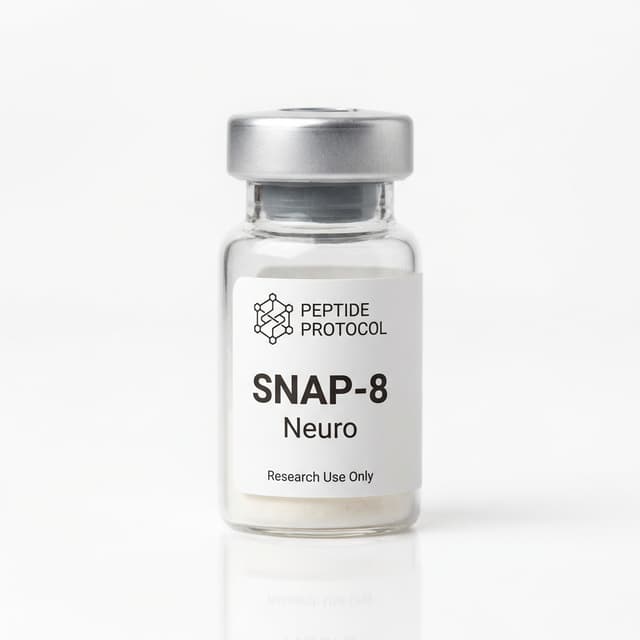
SNAP-8
Quick Reference
- Default Dose
- Topical Spray
- Frequency
- Daily
- Timing
- PM
- Dilution
- 2 mL
Storage
- Lyophilized
- -20°C
- Reconstituted
- 2-8°C
For Practitioners
Interested in offering research-grade compounds through your practice? Learn about our affiliate program for qualified practitioners.
Find a ProviderPractitioner Information