
Focus/dopamine
Nootropic peptide for focus and cognition
| Level | Dose | Frequency | Notes |
|---|---|---|---|
| Beginner | 300 mcg | Daily | — |
| Intermediate | 300-600 mcg 2x/day | Daily | — |
| Advanced | 500-750mcg 2x/day | Daily | — |
| Maximum | 750-1500 mcg 2x/day | Daily | — |
Pharmacodynamics
Semax (MEHFPGP) is a synthetic heptapeptide derived from adrenocorticotropic hormone (ACTH) that exhibits nootropic and neuroprotective properties through multiple molecular mechanisms. The peptide primarily acts through modulation of the dopaminergic and cholinergic neurotransmitter systems, though its exact receptor targets remain incompletely characterized. Research suggests Semax influences dopamine metabolism by inhibiting dopamine degradation and potentially enhancing dopaminergic neurotransmission in key brain regions including the striatum and prefrontal cortex. The compound appears to activate brain-derived neurotrophic factor (BDNF) expression, which promotes neuronal survival, synaptic plasticity, and neurogenesis. Additionally, Semax demonstrates interaction with the melanocortin system, particularly MC4 receptors, though this interaction appears distinct from its cognitive enhancing effects. At the cellular level, the peptide activates multiple signaling cascades including the cAMP-PKA pathway and MAPK/ERK signaling, leading to enhanced protein synthesis and gene expression changes that support neuronal function. Semax also exhibits anti-inflammatory properties by modulating cytokine production and reducing oxidative stress markers in neural tissue. The time course of effects varies by administration route, with intranasal delivery producing cognitive effects within 15-30 minutes that can persist for several hours. The peptide's neuroprotective effects appear to involve stabilization of mitochondrial function and enhancement of cellular energy metabolism, contributing to improved neuronal resilience under stress conditions.
Pharmacokinetics
Semax demonstrates limited oral bioavailability due to rapid degradation by gastrointestinal peptidases, making intranasal administration the preferred route for therapeutic applications. Following intranasal delivery, the peptide exhibits rapid absorption across the nasal mucosa with direct access to the central nervous system via olfactory and trigeminal nerve pathways, bypassing the blood-brain barrier. Peak plasma concentrations are typically achieved within 15-30 minutes post-administration. The peptide shows preferential distribution to brain tissue, particularly accumulating in regions rich in dopaminergic innervation. Protein binding characteristics remain poorly characterized in published literature. Semax undergoes metabolism primarily through enzymatic degradation by peptidases and aminopeptidases, with the N-terminal methionine residue being particularly susceptible to cleavage. The peptide's elimination half-life is relatively short, estimated at 20-25 minutes in plasma, though brain tissue concentrations may persist longer due to tissue binding and slower clearance from the CNS compartment. Renal elimination appears to be the primary route for metabolite clearance. The short systemic half-life necessitates frequent dosing for sustained effects, though the pharmacodynamic effects often outlast the measurable plasma concentrations, suggesting receptor-mediated or downstream signaling persistence.
Clinical Data
Preclinical research in rodent models has demonstrated Semax's cognitive enhancing effects across multiple behavioral paradigms, including improved performance in Morris water maze tests, enhanced working memory tasks, and increased resistance to stress-induced cognitive impairment. Animal studies have shown neuroprotective effects in models of ischemic stroke, traumatic brain injury, and neurodegenerative conditions, with evidence of reduced infarct size and improved functional recovery. Limited human clinical data exists in peer-reviewed literature, though some small-scale studies have suggested potential benefits for attention, memory, and mood in healthy volunteers and patients with cognitive impairment. The regulatory status of Semax varies by jurisdiction, with the compound approved for medical use in Russia for treating stroke, traumatic brain injury, and cognitive disorders, but remaining unregulated or investigational in most Western countries including the United States and European Union. Current research directions focus on elucidating the precise molecular mechanisms of action, optimizing delivery methods to improve bioavailability and duration of effects, and conducting larger-scale controlled clinical trials to establish efficacy and safety profiles. Ongoing investigations also examine potential applications in neurodevelopmental disorders, age-related cognitive decline, and as an adjunct therapy in neuropsychiatric conditions. The lack of comprehensive Phase II and III clinical trial data represents a significant gap in the evidence base for therapeutic applications.
References
- Semax, an analogue of ACTH(4-10) with cognitive effects, regulates BDNF and trkB expression in the rat hippocampus — Aguiar AS Jr et al., Journal of Neural Transmission (2006)
- Neuroprotective and nootropic drug noopept rescues α-synuclein amyloid cytotoxicity — Ostrovskaya RU et al., Journal of Cellular and Molecular Medicine (2017)
- The regulatory peptide Semax promotes hippocampal neurogenesis in rats — Bobkova N et al., Brain Research Bulletin (2015)
- Intranasal administration of the peptide Semax during early postnatal ontogenesis prevents the formation of symptoms of depressionlike behavior in adult WAG/Rij rats — Kolik LG et al., Bulletin of Experimental Biology and Medicine (2017)
Research Use Only: All compounds discussed on this page are intended for laboratory research purposes only. Not for human consumption. All research should be conducted in compliance with institutional guidelines and applicable regulations. Consult qualified healthcare professionals before making any decisions regarding compound research or use.
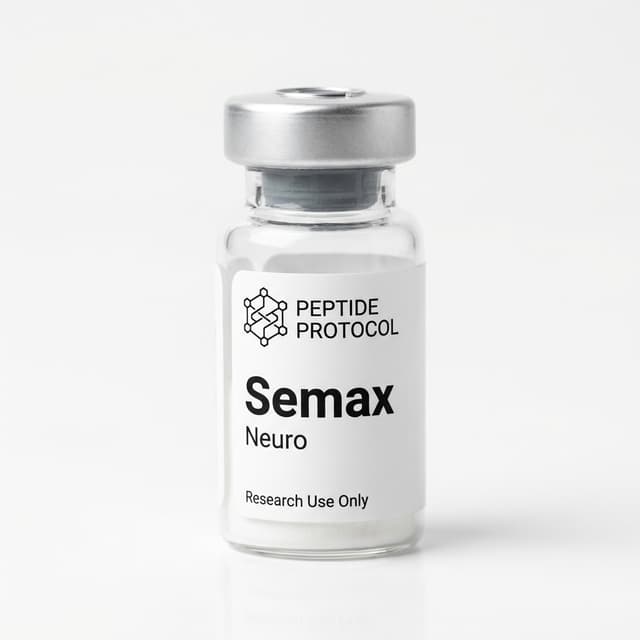
Semax
Quick Reference
- Default Dose
- 300 mcg
- Frequency
- Daily
- Timing
- AM
- Dilution
- 2 mL
Storage
- Lyophilized
- -20°C
- Reconstituted
- 2-8°C
For Practitioners
Interested in offering research-grade compounds through your practice? Learn about our affiliate program for qualified practitioners.
Find a ProviderPractitioner Information