
Cancer cell targeting peptide
Cancer cell targeting peptide
| Level | Dose | Frequency | Notes |
|---|---|---|---|
| Beginner | 0.5-0.75 mg 2x/week | 2-3x/wk | — |
| Intermediate | 1 mg 2x/week | 2-3x/wk | — |
| Advanced | 1-2 mg 3x/week | 2-3x/wk | — |
| Maximum | 2-4 mg 3x/week | 2-3x/wk | — |
Pharmacodynamics
PNC-27 is a synthetic 32-amino acid peptide that represents a fusion of a membrane-disrupting sequence derived from bee venom melittin and a p53-binding domain. The peptide's primary mechanism of action involves selective targeting of cancer cells through interaction with HDM-2 (human double minute 2) protein, which is frequently overexpressed on the surface of malignant cells. In normal cells, HDM-2 primarily functions intracellularly as a negative regulator of the p53 tumor suppressor protein. However, in many cancer cell types, HDM-2 becomes aberrantly expressed on the cell membrane, providing a unique target for PNC-27. Upon binding to membrane-bound HDM-2, PNC-27 undergoes conformational changes that activate its membrane-disrupting properties derived from the melittin component. This leads to the formation of transmembrane pores, resulting in selective cancer cell death through necrosis. The selectivity mechanism is attributed to the differential expression of HDM-2 on cancer cell membranes compared to normal cells, which typically do not express significant levels of HDM-2 on their surface. Preclinical studies suggest that PNC-27 can induce rapid cell death in various cancer cell lines within hours of treatment, with minimal effects on normal cells that lack surface HDM-2 expression. The peptide's cytotoxic effects appear to be independent of p53 status, making it potentially effective against both p53-wild-type and p53-mutant cancers.
Pharmacokinetics
The pharmacokinetic profile of PNC-27 has been primarily characterized through preclinical studies, with limited human pharmacokinetic data available. As a synthetic peptide, PNC-27 is typically administered via intravenous infusion to ensure adequate bioavailability, as oral administration would likely result in degradation by gastrointestinal proteases. Following intravenous administration, the peptide demonstrates rapid distribution throughout the body, with preferential accumulation in tumor tissues expressing surface HDM-2. The peptide's relatively small molecular weight (approximately 3.6 kDa) allows for reasonable tissue penetration, though specific distribution volume data remains limited. Like most therapeutic peptides, PNC-27 is subject to proteolytic degradation by plasma and tissue peptidases, which represents the primary route of metabolism. The elimination half-life appears to be relatively short, consistent with other peptide therapeutics, likely ranging from 1-4 hours based on structural analogs, though specific pharmacokinetic parameters require further clinical characterization. Renal clearance may contribute to elimination of metabolites, though the intact peptide's clearance mechanisms have not been fully elucidated in human studies.
Clinical Data
Clinical research on PNC-27 remains in early-stage development, with most published evidence derived from preclinical studies. In vitro studies have demonstrated selective cytotoxicity against various cancer cell lines, including breast, pancreatic, melanoma, and other solid tumor types, while showing minimal toxicity to normal cell lines. Animal studies have suggested potential anticancer efficacy with manageable toxicity profiles, though comprehensive toxicology and safety data remain limited. Early-phase human clinical trials have been conducted, but published results are scarce and primarily consist of case reports or small case series rather than controlled clinical studies. The regulatory status of PNC-27 varies by jurisdiction, and it has not received approval from major regulatory agencies such as the FDA or EMA for cancer treatment. Some clinical use has occurred in alternative medicine settings, but this lacks the rigorous oversight of formal clinical trials. The peptide remains largely investigational, with ongoing research focused on better understanding its mechanism of action, optimizing dosing regimens, and establishing safety profiles. Current research directions include combination therapy approaches, improved formulation strategies to enhance stability and delivery, and identification of biomarkers to predict treatment response. More robust clinical trial data will be essential for regulatory consideration and establishing evidence-based treatment protocols.
References
- PNC-27, a chimeric p53-penetratin peptide binds to HDM-2 in a p53 peptide-like structure — Sarafraz-Yazdi E et al., Anticancer Research (2010)
- PNC-27 induces selective tumor cell lysis in a variety of cancer cell lines — Warso MA et al., Anticancer Research (2013)
- HDM-2 (human double minute-2) is expressed on the surface of cancer cells — Sarafraz-Yazdi E et al., Cancer Biology & Therapy (2010)
Research Use Only: All compounds discussed on this page are intended for laboratory research purposes only. Not for human consumption. All research should be conducted in compliance with institutional guidelines and applicable regulations. Consult qualified healthcare professionals before making any decisions regarding compound research or use.
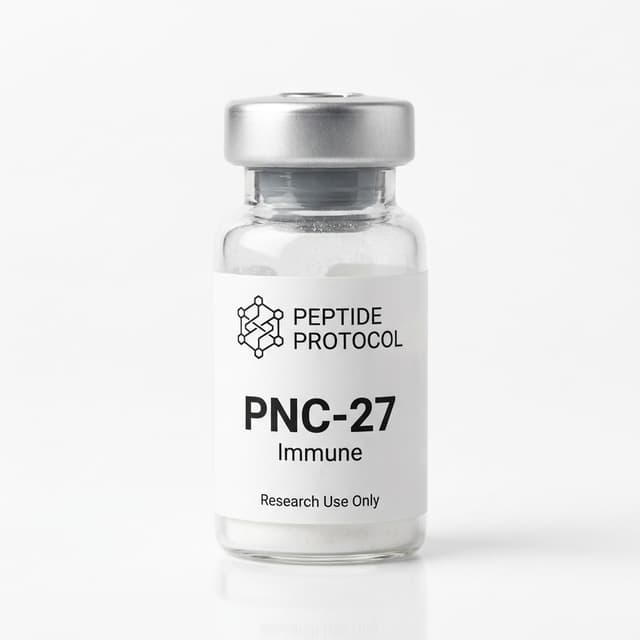
PNC-27
Quick Reference
- Default Dose
- 0.5-0.75 mg 2x/week
- Frequency
- 2-3x/wk
- Timing
- AM
- Dilution
- 1 mL
Storage
- Lyophilized
- -20°C
- Reconstituted
- 2-8°C
For Practitioners
Interested in offering research-grade compounds through your practice? Learn about our affiliate program for qualified practitioners.
Find a ProviderPractitioner Information