
Antimicrobial
Antimicrobial peptide for immune support
| Level | Dose | Frequency | Notes |
|---|---|---|---|
| Beginner | 50-100 mcg | Daily | — |
| Intermediate | 100 mcg 2x/day | Daily | — |
| Advanced | 200-300 mcg | Daily | — |
| Maximum | 250 mg 2x/day | Daily | — |
Pharmacodynamics
LL-37 is a cationic antimicrobial peptide derived from the C-terminal region of human cathelicidin hCAP18. Its primary mechanism of action involves direct interaction with bacterial cell membranes through electrostatic attraction between its positively charged amino acid residues and the negatively charged phospholipids and lipopolysaccharides present in bacterial membranes. Upon binding, LL-37 adopts an amphipathic α-helical structure that allows it to insert into and disrupt membrane integrity through the formation of transmembrane pores or complete membrane destabilization. This leads to rapid bacterial cell death through osmotic lysis and leakage of intracellular contents. Beyond its direct antimicrobial activity, LL-37 exhibits immunomodulatory properties by binding to various host cell receptors including formyl peptide receptor-like 1 (FPRL1), P2X7 purinergic receptors, and epidermal growth factor receptor (EGFR). These interactions trigger downstream signaling cascades involving MAPK pathways, leading to enhanced chemokine and cytokine production, neutrophil chemotaxis, and wound healing responses. LL-37 also demonstrates the ability to neutralize bacterial endotoxins and enhance phagocytosis by immune cells. The peptide's effects are typically rapid, with membrane disruption occurring within minutes of contact, while immunomodulatory effects develop over hours through gene transcription and protein synthesis pathways. Additionally, LL-37 can bind and neutralize bacterial DNA and RNA, providing an additional mechanism for antimicrobial activity.
Pharmacokinetics
LL-37 demonstrates complex pharmacokinetic properties that vary significantly based on the route of administration. When administered topically, the peptide shows good local tissue penetration but limited systemic absorption, making it suitable for wound and skin infection applications. Following intravenous administration in preclinical models, LL-37 exhibits rapid distribution to tissues with high blood flow, including lungs, liver, and kidneys. The peptide shows moderate protein binding, primarily to albumin and other plasma proteins, which may influence its bioavailability and duration of action. LL-37 is subject to enzymatic degradation by various proteases, including neutrophil elastase, cathepsin G, and matrix metalloproteinases, which represent the primary metabolic pathways. This proteolytic degradation contributes to its relatively short plasma half-life, estimated to be in the range of 30 minutes to 2 hours based on in vitro and animal studies. Elimination occurs primarily through renal clearance of peptide fragments, though some intact peptide may be cleared through hepatic metabolism. The peptide's stability can be influenced by local tissue conditions, with increased degradation observed in inflammatory environments where protease activity is elevated. These pharmacokinetic characteristics suggest that LL-37 may require frequent dosing or sustained-release formulations for therapeutic applications requiring prolonged activity.
Clinical Data
Preclinical research on LL-37 has demonstrated broad-spectrum antimicrobial activity against gram-positive and gram-negative bacteria, fungi, and certain viruses in both in vitro and animal model studies. Studies in mouse models of skin and soft tissue infections have shown that topical LL-37 application can accelerate wound healing and reduce bacterial burden. Research in chronic wound models has indicated potential therapeutic benefit in diabetic ulcers and other non-healing wounds, where endogenous LL-37 levels are often reduced. Limited human studies have primarily focused on observational research examining LL-37 levels in various disease states, including atopic dermatitis, psoriasis, and chronic wounds, generally showing decreased endogenous peptide production in diseased tissue. Small-scale clinical investigations have explored topical LL-37 formulations for wound care applications, though comprehensive phase II/III clinical trial data remains limited. Currently, LL-37 does not have regulatory approval as a therapeutic agent from major regulatory bodies such as the FDA or EMA, though it remains an active area of pharmaceutical development. Several companies have developed synthetic LL-37 analogs and formulations that are in various stages of preclinical and early clinical development. Ongoing research directions include optimization of peptide stability, development of sustained-release formulations, and investigation of combination therapies with conventional antimicrobials. The peptide's dual antimicrobial and immunomodulatory properties make it an attractive candidate for treating antibiotic-resistant infections and promoting tissue repair.
References
- The human cationic antimicrobial protein LL-37 stimulates endothelial cell migration and angiogenesis — Koczulla R et al., Biochemical and Biophysical Research Communications (2003)DOIPubMed
- LL-37, the only human member of the cathelicidin family of antimicrobial peptides — Zanetti M, Biochimica et Biophysica Acta (2004)DOIPubMed
- Human antimicrobial peptide LL-37 inhibits adhesion of Candida albicans by interacting with yeast cell-wall carbohydrates — López-García B et al., PLoS One (2015)DOIPubMed
- Antimicrobial peptide LL-37 promotes wound healing in a pH- and protein-dependent manner — Säll J et al., Acta Dermato-Venereologica (2013)DOIPubMed
Research Use Only: All compounds discussed on this page are intended for laboratory research purposes only. Not for human consumption. All research should be conducted in compliance with institutional guidelines and applicable regulations. Consult qualified healthcare professionals before making any decisions regarding compound research or use.
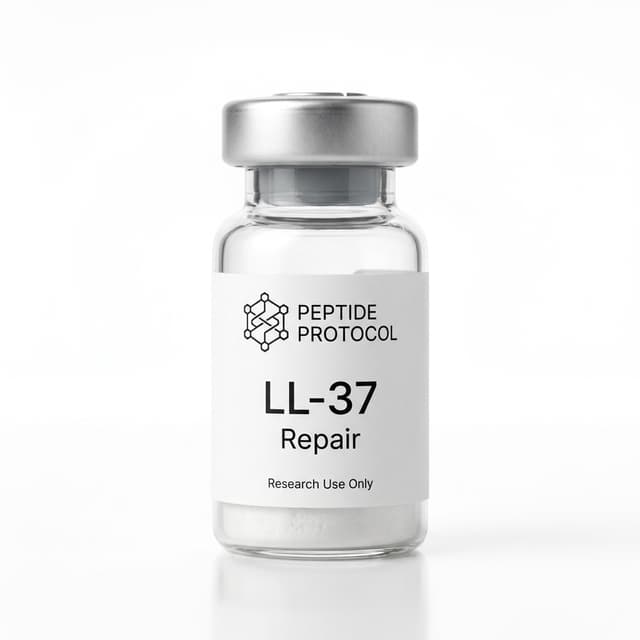
LL-37
Quick Reference
- Default Dose
- 50-100 mcg
- Frequency
- Daily
- Timing
- AM
- Dilution
- 1 mL
Storage
- Lyophilized
- -20°C
- Reconstituted
- 2-8°C
For Practitioners
Interested in offering research-grade compounds through your practice? Learn about our affiliate program for qualified practitioners.
Find a ProviderPractitioner Information