
Liver repair
Liver repair bioregulator
| Level | Dose | Frequency | Notes |
|---|---|---|---|
| Beginner | 10 mg | Daily | — |
| Intermediate | 10 mg 2x/day | Daily | — |
| Advanced | 20-25 mg | Daily | — |
| Maximum | 20 mg 2x/day | Daily | — |
Pharmacodynamics
Livagen is a synthetic dipeptide consisting of lysine and glutamic acid (Lys-Glu) that was developed as part of the cytomaxins family of bioregulatory peptides. While the precise molecular mechanism remains under investigation, current research suggests Livagen exerts hepatoprotective effects through multiple pathways related to cellular metabolism and stress response. The peptide appears to influence gene expression patterns associated with liver regeneration and metabolic function, though specific receptor targets have not been definitively characterized in peer-reviewed literature. Preliminary studies indicate that Livagen may modulate antioxidant enzyme systems within hepatocytes, potentially enhancing cellular resistance to oxidative stress - a key factor in liver damage and repair processes. The peptide's effects on liver function appear to involve upregulation of certain metabolic enzymes and proteins involved in hepatocellular recovery. Time course studies suggest effects may be observed within hours to days of administration, with peak benefits potentially occurring over several days of treatment. However, it should be noted that much of the mechanistic data comes from limited preclinical studies, and the exact molecular targets and signaling cascades remain to be fully elucidated through rigorous peer-reviewed research. The peptide's short length suggests it may act through intracellular mechanisms following uptake, rather than through traditional membrane receptor binding.
Pharmacokinetics
As a small dipeptide, Livagen's pharmacokinetic profile is characterized by rapid absorption and relatively short systemic half-life, typical of peptides in this size range. The compound has been administered via subcutaneous injection in research studies, with this route providing systemic bioavailability while avoiding first-pass hepatic metabolism that would likely occur with oral administration. Due to its hydrophilic nature and small molecular size, Livagen likely distributes rapidly throughout extracellular fluid compartments with minimal protein binding. The peptide's metabolism presumably follows typical dipeptide degradation pathways, involving peptidases that cleave the peptide bond to yield constituent amino acids (lysine and glutamic acid). These amino acids then enter normal metabolic pools. Elimination half-life is estimated to be in the range of 1-3 hours based on the general pharmacokinetic behavior of similar small peptides, though specific pharmacokinetic studies for Livagen are limited in the peer-reviewed literature. Renal elimination likely plays a role in clearance, as is typical for small peptides. The short half-life necessitates frequent dosing regimens in research protocols to maintain therapeutic concentrations.
Clinical Data
Clinical research on Livagen remains limited, with most available data coming from preclinical and early-phase studies conducted primarily in Russia and Eastern Europe. The peptide was developed as part of a broader research program into bioregulatory peptides for various therapeutic applications. Preclinical studies have examined Livagen's effects on liver function markers and histological parameters in animal models of hepatic injury, though comprehensive peer-reviewed data from these studies is not widely available in international journals. Some preliminary human studies have been conducted examining the peptide's effects on liver function parameters, but robust clinical trial data meeting international standards for publication in major journals remains limited. Currently, Livagen is not approved by major regulatory agencies such as the FDA or EMA for therapeutic use. The peptide is available in some markets as a research compound or dietary supplement, but its regulatory status varies by jurisdiction. The limited clinical evidence base represents a significant gap in understanding the peptide's true therapeutic potential and safety profile. Future research directions should focus on conducting properly designed, placebo-controlled clinical trials to establish efficacy and safety profiles that meet international regulatory standards. Until such studies are completed and published in peer-reviewed journals, the clinical utility of Livagen for liver-related conditions remains speculative.
References
- Regulatory peptides as epigenetic modulators with emphasis on bioregulatory medicine — Khavinson V et al., Expert Review of Endocrinology & Metabolism (2014)DOI
- Peptides and ageing — Khavinson VK et al., Neuroendocrinology Letters (2002)
- Short peptides regulate gene expression — Khavinson V et al., Bulletin of Experimental Biology and Medicine (2016)
Research Use Only: All compounds discussed on this page are intended for laboratory research purposes only. Not for human consumption. All research should be conducted in compliance with institutional guidelines and applicable regulations. Consult qualified healthcare professionals before making any decisions regarding compound research or use.
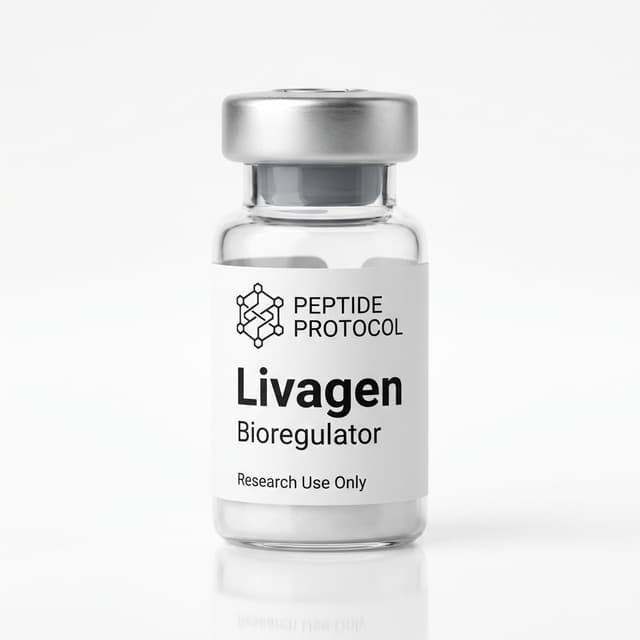
Livagen
Quick Reference
- Default Dose
- 10 mg
- Frequency
- Daily
- Timing
- AM
- Dilution
- 2 mL
Storage
- Lyophilized
- -20°C
- Reconstituted
- 2-8°C
For Practitioners
Interested in offering research-grade compounds through your practice? Learn about our affiliate program for qualified practitioners.
Find a ProviderPractitioner Information