
Anti-aging, cell survival
Anti-aging, cell survival
| Level | Dose | Frequency | Notes |
|---|---|---|---|
| Beginner | 2 mg 2x/week | Daily | Use case: -New to mitochondrial peptides -Baseline resilience support -Longevity-first mindset What this tier does well: -Establishes cellular protection without introducing adaptation stress. -This is where cautious operators should start. No drama. |
| Intermediate | 4 mg 3x/week | Daily | Use case: -Mild metabolic stress -Light performance stacking -Recovery-focused protocols What changes here: -You’re no longer just protecting—you’re buffering against daily stress load. |
| Advanced | 5mg 3x/week | Daily | Use case: -Heavy training blocks -Aggressive fat loss or GH-axis work -Mitochondrial stacks (SS-31, MOTS-c in play) This tier is where Humanin earns its keep. -Cells are under pressure. Humanin keeps them from folding. |
| Maximum | 10 mg 2x/week | Daily | Use case: -Long-duration stress exposure -Advanced stacks -Aging + performance overlap Important framing: This is not about “more is better.” This tier assumes the user understands why Humanin is in the stack. |
Pharmacodynamics
Humanin is a 24-amino acid mitochondrial-derived peptide that exerts cytoprotective effects through multiple molecular pathways. The peptide primarily binds to a tripartite receptor complex consisting of ciliary neurotrophic factor receptor α (CNTFRα), WSX-1 (IL-27Rα), and gp130, which activates the JAK2/STAT3 signaling pathway. This interaction leads to phosphorylation of STAT3, which translocates to the nucleus and promotes transcription of anti-apoptotic genes including Bcl-2 and survivin. Humanin also demonstrates direct binding to pro-apoptotic proteins, particularly Bax and tBid, preventing their translocation to mitochondria and subsequent cytochrome c release. Additionally, the peptide activates the PI3K/Akt survival pathway, which phosphorylates and inactivates pro-apoptotic proteins like Bad and FoxO transcription factors. At the cellular level, humanin treatment results in enhanced mitochondrial function, reduced oxidative stress, and improved cellular energy metabolism. The peptide also modulates calcium homeostasis and prevents mitochondrial permeability transition pore opening. In neuronal cells, humanin exhibits neuroprotective effects by reducing amyloid-β toxicity and tau phosphorylation, while in muscle and cardiac tissue, it enhances insulin sensitivity and metabolic function. The cytoprotective effects typically manifest within 2-6 hours of treatment and can persist for 24-48 hours, suggesting both immediate signaling effects and longer-term transcriptional changes.
Pharmacokinetics
Humanin demonstrates rapid systemic absorption following subcutaneous or intraperitoneal administration, with peak plasma concentrations typically achieved within 15-30 minutes. The peptide shows good tissue distribution, readily crossing the blood-brain barrier through an unknown mechanism, though this may involve specific peptide transporters. Plasma protein binding appears to be moderate, allowing for significant free peptide availability. The peptide is primarily metabolized through proteolytic degradation by peptidases and aminopeptidases, with the liver and kidneys serving as major sites of clearance. The plasma half-life of native humanin is relatively short, estimated at 30-60 minutes in rodent models, necessitating frequent dosing or the use of modified analogs for sustained effects. Renal elimination appears to be a minor pathway for the intact peptide, with most clearance occurring through enzymatic degradation. Several synthetic analogs have been developed with improved stability and extended half-lives, including HNG (humanin-G) and colivelin, which demonstrate enhanced resistance to proteolytic degradation and prolonged biological activity.
Clinical Data
Preclinical studies have demonstrated humanin's efficacy across multiple disease models, including Alzheimer's disease, stroke, myocardial infarction, and diabetes. In transgenic mouse models of Alzheimer's disease, humanin treatment reduced amyloid-β accumulation, improved cognitive function, and extended lifespan. Cardiovascular studies have shown that humanin administration reduces infarct size in ischemic heart disease models and improves endothelial function. Metabolic research has revealed that humanin enhances insulin sensitivity and glucose metabolism in diabetic animal models. Human clinical data remains limited, though observational studies have identified correlations between endogenous humanin levels and aging-related conditions. Lower plasma humanin concentrations have been associated with Alzheimer's disease severity, cardiovascular risk, and metabolic dysfunction in elderly populations. Currently, humanin and its analogs are in preclinical development stages, with no approved therapeutic applications. The peptide's regulatory status remains investigational, though its endogenous nature and favorable safety profile in animal studies suggest potential for clinical translation. Research directions include development of more stable analogs, optimization of delivery methods, and exploration of combination therapies for age-related diseases. Several pharmaceutical companies are investigating humanin-based therapeutics for neurodegenerative diseases and metabolic disorders.
References
- Humanin: a harbinger of mitochondrial-derived peptides? — Lee C et al., Trends in Endocrinology & Metabolism (2013)DOIPubMed
- Humanin and its derivatives: a potential therapeutic for Alzheimer's disease — Muzumdar RH et al., Current Pharmaceutical Design (2009)PubMed
- The mitochondrial-derived peptide humanin activates the ERK1/2, AKT, and STAT3 signaling pathways and has age-dependent signaling differences in the hippocampus — Kumfu S et al., Journal of Biological Chemistry (2018)DOIPubMed
- Humanin prevents age-related cognitive decline in mice and is associated with improved cognitive age in humans — Yen K et al., Scientific Reports (2018)DOIPubMed
Research Use Only: All compounds discussed on this page are intended for laboratory research purposes only. Not for human consumption. All research should be conducted in compliance with institutional guidelines and applicable regulations. Consult qualified healthcare professionals before making any decisions regarding compound research or use.
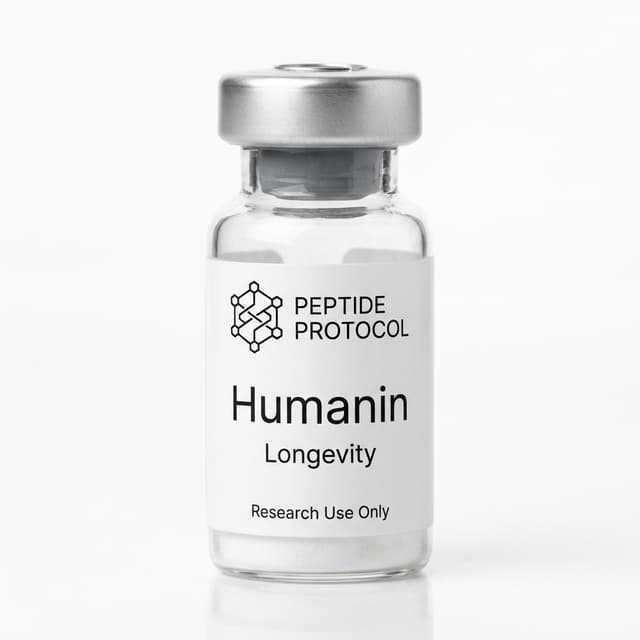
Humanin
Quick Reference
- Default Dose
- 2 mg 2x/week
- Frequency
- Daily
- Timing
- PM
- Dilution
- 1 mL
Storage
- Lyophilized
- -20°C
- Reconstituted
- 2-8°C
For Practitioners
Interested in offering research-grade compounds through your practice? Learn about our affiliate program for qualified practitioners.
Find a ProviderPractitioner Information