
GH releasing peptide
GH releasing peptide
| Level | Dose | Frequency | Notes |
|---|---|---|---|
| Beginner | 200 mcg | 2-3x/day | — |
| Intermediate | 300 mcg | 2-3x/day | — |
| Advanced | 250 mcg 2x/day | 2-3x/day | — |
| Maximum | 500 mg 2-3x/day | 2-3x/day | — |
Pharmacodynamics
GHRP-2 (Growth Hormone Releasing Peptide-2) is a synthetic hexapeptide that functions as a potent growth hormone secretagogue through its action on the ghrelin receptor (GHS-R1a). The peptide exhibits high binding affinity for GHS-R1a receptors located primarily in the anterior pituitary gland, hypothalamus, and peripheral tissues. Upon receptor binding, GHRP-2 activates Gq/G11 protein-coupled signaling pathways, leading to increased intracellular calcium mobilization and activation of protein kinase C. This cascade ultimately stimulates the release of growth hormone from somatotroph cells in the anterior pituitary. The mechanism involves both direct pituitary stimulation and indirect effects through hypothalamic growth hormone-releasing hormone (GHRH) neurons. GHRP-2 demonstrates synergistic effects when combined with endogenous GHRH, resulting in amplified growth hormone release compared to either compound alone. The peptide also exhibits some affinity for CD36 receptors, though the physiological significance of this interaction remains under investigation. Growth hormone release typically peaks within 15-30 minutes following administration, with effects lasting 2-3 hours. The peptide shows minimal desensitization with repeated administration, unlike some other growth hormone secretagogues. Additionally, GHRP-2 may influence other hormonal pathways, including modest effects on prolactin and ACTH release, though these are generally considered secondary to its primary growth hormone-releasing activity.
Pharmacokinetics
GHRP-2 is typically administered via subcutaneous or intravenous injection due to its peptide structure, which renders it susceptible to gastrointestinal degradation when taken orally. Following subcutaneous administration, the peptide demonstrates rapid absorption with peak plasma concentrations achieved within 15-30 minutes. The bioavailability via subcutaneous route is estimated to be approximately 70-80% compared to intravenous administration. Distribution studies indicate limited tissue penetration beyond the vascular compartment, with the peptide primarily remaining in plasma and extracellular fluid. Protein binding appears to be minimal, allowing for rapid clearance from circulation. Metabolism occurs primarily through enzymatic degradation by peptidases and proteases in plasma and tissues, following typical pathways for small peptides. The elimination half-life is relatively short, ranging from 15-30 minutes in most studies, necessitating multiple daily administrations for sustained effects. Renal clearance contributes to elimination, though the majority of the peptide is metabolized rather than excreted unchanged. The rapid clearance profile is consistent with other growth hormone releasing peptides and reflects the general instability of small peptides in biological systems.
Clinical Data
Preclinical studies in various animal models have consistently demonstrated GHRP-2's efficacy in stimulating growth hormone release, with effects observed across multiple species including rats, pigs, and non-human primates. These studies have shown dose-dependent increases in growth hormone levels, with corresponding effects on IGF-1 concentrations and growth parameters. Human clinical trials have been limited but have generally confirmed the peptide's growth hormone-releasing properties. Early phase studies in healthy adults demonstrated significant increases in growth hormone levels following GHRP-2 administration, with peak responses occurring within 30-60 minutes. Some small-scale studies have investigated potential therapeutic applications in growth hormone deficiency states, showing promising but preliminary results. However, comprehensive phase III clinical trials for specific therapeutic indications remain limited. Currently, GHRP-2 is not approved by major regulatory agencies such as the FDA or EMA for therapeutic use, and it remains classified as an investigational compound. The peptide is primarily used in research settings to study growth hormone physiology and regulation. Ongoing research interests include potential applications in age-related growth hormone decline, muscle wasting conditions, and metabolic disorders, though these applications require further clinical validation. Safety profiles from available studies suggest generally good tolerability, though long-term safety data remains limited.
References
- Growth hormone-releasing activity of hexarelin, a new synthetic hexapeptide, after intravenous, subcutaneous, intranasal, and oral administration in man — Ghigo E et al., European Journal of Endocrinology (1994)PubMed
- Ghrelin receptor agonists: characterization of their endocrinological and pharmacological properties — Holst B et al., Basic & Clinical Pharmacology & Toxicology (2004)PubMed
- Growth hormone (GH)-releasing peptide stimulation of GH release from human somatotrophs transplanted into athymic mice — Hickey GJ et al., Endocrinology (1994)PubMed
- Pharmacological characterization of a growth hormone-releasing hexapeptide (GHRP-2) — Ong H et al., Life Sciences (1998)PubMed
Research Use Only: All compounds discussed on this page are intended for laboratory research purposes only. Not for human consumption. All research should be conducted in compliance with institutional guidelines and applicable regulations. Consult qualified healthcare professionals before making any decisions regarding compound research or use.
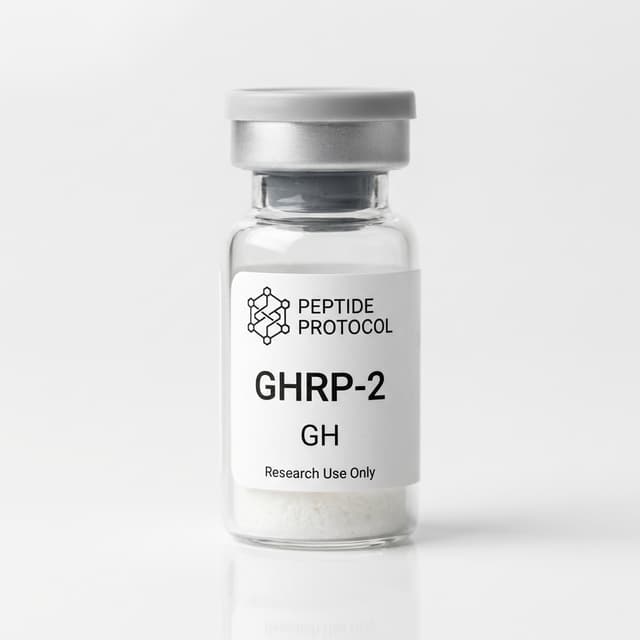
GHRP-2
Quick Reference
- Default Dose
- 200 mcg
- Frequency
- 2-3x/day
- Timing
- AM/PM
- Dilution
- 2 mL
Storage
- Lyophilized
- -20°C
- Reconstituted
- 2-8°C
For Practitioners
Interested in offering research-grade compounds through your practice? Learn about our affiliate program for qualified practitioners.
Find a ProviderPractitioner Information