
Collagen, hair, healing
Copper peptide for collagen and healing
| Level | Dose | Frequency | Notes |
|---|---|---|---|
| Beginner | 1 mg | Daily (topical) | — |
| Intermediate | 2 mg | Daily (topical) | — |
| Advanced | 3 mg | Daily (topical) | — |
| Maximum | 5 mg | Daily (topical) | — |
Pharmacodynamics
GHK-Cu exerts its biological effects primarily through modulation of gene expression and activation of multiple cellular signaling pathways. The copper ion within the complex is essential for its activity, as it facilitates binding to cell surface receptors and enables the peptide to cross cellular membranes. Once internalized, GHK-Cu influences the expression of over 4,000 human genes, with particularly strong effects on genes involved in tissue repair, collagen synthesis, and inflammation regulation. The peptide upregulates genes encoding collagen types I and III, elastin, and various glycosaminoglycans, while simultaneously downregulating pro-inflammatory cytokines and matrix metalloproteinases (MMPs) that degrade extracellular matrix components. GHK-Cu activates transforming growth factor-beta (TGF-β) signaling pathways, which are crucial for wound healing and tissue remodeling. It also stimulates the production of vascular endothelial growth factor (VEGF), promoting angiogenesis and improved blood supply to healing tissues. At the cellular level, GHK-Cu enhances fibroblast proliferation and migration, increases keratinocyte activity, and promotes the differentiation of stem cells into various tissue-specific cell types. The peptide demonstrates antioxidant properties by increasing the expression of antioxidant enzymes and reducing oxidative stress markers. Effects on collagen synthesis typically become apparent within 24-48 hours of treatment, with maximal effects observed after 72-96 hours of continuous exposure in in vitro studies.
Pharmacokinetics
GHK-Cu can be administered through multiple routes including topical, subcutaneous, and intravenous applications, with topical administration being most common for cosmetic applications. When applied topically, the peptide demonstrates good skin penetration due to its small molecular size (approximately 340 Da) and the presence of the copper ion, which facilitates cellular uptake. The compound shows affinity for binding to albumin and other plasma proteins, which may extend its circulation time. Distribution studies indicate that GHK-Cu accumulates preferentially in wounded or inflamed tissues, suggesting a natural targeting mechanism. The peptide is metabolized primarily through enzymatic degradation by peptidases and proteases, with the copper ion being incorporated into cellular copper pools or bound to metallothioneins. Elimination occurs through both renal and hepatic pathways, with the peptide components being broken down into constituent amino acids that enter normal metabolic pathways. The plasma half-life of GHK-Cu is relatively short, estimated at 30 minutes to 2 hours depending on the route of administration, though tissue-bound peptide may remain active for extended periods. Repeated dosing is typically required to maintain therapeutic levels.
Clinical Data
Preclinical studies have demonstrated GHK-Cu's efficacy in multiple animal models of wound healing, skin aging, and hair loss. In rat wound healing models, topical GHK-Cu application significantly accelerated wound closure rates and improved the quality of healed tissue with enhanced collagen deposition and reduced scar formation. Studies in aged mice showed that GHK-Cu treatment restored youthful gene expression patterns in skin and liver tissues. Human clinical trials, while limited, have shown promising results for cosmetic applications. Small-scale studies have reported improvements in skin elasticity, firmness, and overall appearance following topical GHK-Cu treatment over 8-12 week periods. Hair growth studies have indicated potential benefits for androgenetic alopecia, with some participants showing increased hair density and thickness. However, larger, randomized controlled trials are needed to establish definitive clinical efficacy and optimal dosing regimens. Currently, GHK-Cu is available as a cosmetic ingredient in many countries but is not approved as a pharmaceutical drug by major regulatory agencies. The peptide is generally well-tolerated with minimal reported side effects, primarily limited to occasional skin irritation with topical use. Ongoing research is investigating its potential for treating chronic wounds, age-related skin changes, and as an adjunct therapy for various dermatological conditions.
References
- The human tripeptide GHK-Cu in prevention of oxidative stress and degenerative conditions of aging: implications for cognitive health — Pickart L et al., Oxidative Medicine and Cellular Longevity (2012)DOI
- Regenerative and protective actions of the GHK-Cu peptide in the light of the new gene data — Pickart L et al., BioMed Research International (2018)DOI
- The effect of the human peptide GHK on gene expression relevant to nervous system function and cognitive decline — Pickart L et al., Brain Sciences (2017)
- Copper peptides as modulators of enzymatic activity and as anti-inflammatory agents — Hostynek JJ et al., Inflammation Research (1993)
Research Use Only: All compounds discussed on this page are intended for laboratory research purposes only. Not for human consumption. All research should be conducted in compliance with institutional guidelines and applicable regulations. Consult qualified healthcare professionals before making any decisions regarding compound research or use.
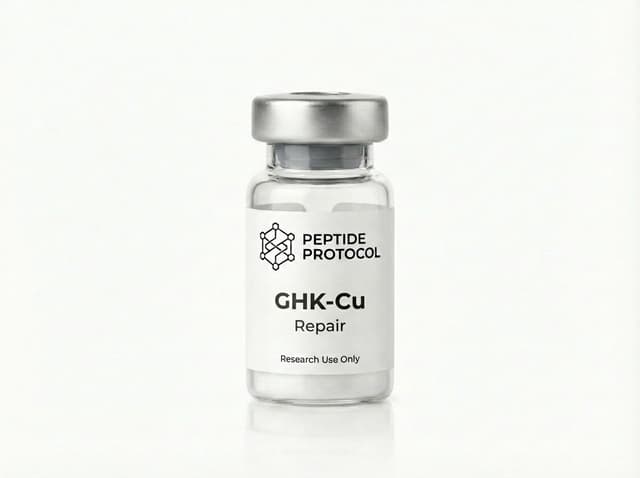
GHK-Cu
Quick Reference
- Default Dose
- 1 mg
- Frequency
- Daily (topical)
- Timing
- PM
- Dilution
- 2 mL
Storage
- Lyophilized
- -20°C
- Reconstituted
- 2-8°C
For Practitioners
Interested in offering research-grade compounds through your practice? Learn about our affiliate program for qualified practitioners.
Find a ProviderPractitioner Information