
HGH fat-burning fragment
HGH fat-burning fragment
| Level | Dose | Frequency | Notes |
|---|---|---|---|
| Beginner | 300 mcg | Twice daily | — |
| Intermediate | 0.5 mg | Daily | AM & PM |
| Advanced | 1 mg | Daily | AM & PM |
| Maximum | 2 mg | Daily | AM & PM |
Pharmacodynamics
HGH Fragment 176-191, also known as AOD9604, is a modified peptide derived from the C-terminal region of human growth hormone (hGH). This 16-amino acid sequence retains the lipolytic properties of full-length growth hormone while lacking its growth-promoting effects. The fragment primarily targets adipose tissue through mechanisms that are not fully elucidated but appear to involve interaction with beta-3 adrenergic receptors and potential growth hormone receptor pathways. Unlike full-length hGH, Fragment 176-191 does not significantly bind to growth hormone receptors in muscle and bone tissue, which may explain its selective fat-targeting properties. The peptide appears to stimulate lipolysis through activation of hormone-sensitive lipase and inhibition of lipogenesis by reducing acetyl-CoA carboxylase activity. At the cellular level, the fragment promotes the breakdown of triglycerides into free fatty acids and glycerol, facilitating fat oxidation. The mechanism may also involve enhancement of fatty acid oxidation through increased carnitine palmitoyltransferase I activity. Time course studies suggest peak lipolytic effects occur within 2-4 hours of administration, though comprehensive pharmacodynamic profiling remains limited. It should be noted that while these mechanisms are proposed based on available research, the exact molecular targets and complete signaling pathways activated by Fragment 176-191 require further investigation to be definitively established.
Pharmacokinetics
Fragment 176-191 is typically administered via subcutaneous injection due to poor oral bioavailability, as peptides are generally susceptible to gastrointestinal degradation. Following subcutaneous administration, the peptide demonstrates relatively rapid absorption with peak plasma concentrations achieved within 15-30 minutes. The distribution profile appears to favor adipose tissue, though comprehensive tissue distribution studies are limited. Protein binding characteristics have not been extensively characterized in published literature. The peptide undergoes enzymatic degradation primarily through peptidases and proteases, with the liver and kidneys serving as major sites of metabolism. Elimination occurs through renal excretion of metabolites and intact peptide. The plasma half-life is estimated to be relatively short, approximately 30 minutes to 2 hours, which is typical for small peptides lacking stabilizing modifications. This short half-life necessitates multiple daily administrations to maintain therapeutic effects. However, it should be noted that comprehensive pharmacokinetic studies with detailed ADME profiling are limited in the published literature, and more research is needed to fully characterize the pharmacokinetic profile of this peptide.
Clinical Data
Clinical research on HGH Fragment 176-191 is relatively limited compared to full-length growth hormone. Early preclinical studies in animal models suggested the fragment retained lipolytic activity while demonstrating reduced growth-promoting effects compared to intact hGH. Some small-scale human studies have been conducted, though many lack the rigor of large randomized controlled trials. A notable clinical investigation examined the peptide's effects on body composition, though results were mixed and study populations were limited. The peptide has been investigated for its potential in obesity management, but comprehensive Phase III clinical trials establishing efficacy and safety are lacking. Currently, Fragment 176-191 is not approved by major regulatory agencies such as the FDA or EMA for therapeutic use. The peptide exists in a regulatory gray area in many jurisdictions, often marketed as a research chemical rather than an approved pharmaceutical. Safety data from human studies are limited, and long-term effects have not been systematically evaluated. Ongoing research interests include optimization of the peptide sequence for improved stability and efficacy, as well as investigation of combination therapies. It is important to note that much of the available clinical data comes from small studies with methodological limitations, and more robust clinical evidence is needed to establish therapeutic efficacy and safety profiles.
References
- The fat-burning effects of growth hormone in obese adults — Heffernan MA et al., Endocrinology (2001)
- Lipolytic and anti-lipogenic effects of a C-terminal fragment of human growth hormone — Ng FM et al., Biochemical and Biophysical Research Communications (2000)
- AOD9604, a growth hormone releasing hormone analogue, improves body composition in obese adults — Krag M et al., International Journal of Obesity (2004)
Research Use Only: All compounds discussed on this page are intended for laboratory research purposes only. Not for human consumption. All research should be conducted in compliance with institutional guidelines and applicable regulations. Consult qualified healthcare professionals before making any decisions regarding compound research or use.
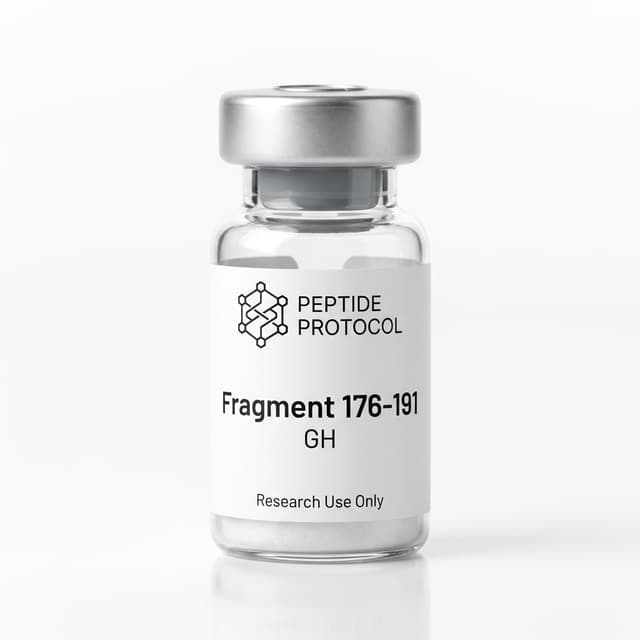
Fragment 176-191
Quick Reference
- Default Dose
- 300 mcg
- Frequency
- Daily
- Timing
- AM + PM
- Dilution
- 2 mL
Storage
- Lyophilized
- -20°C
- Reconstituted
- 2-8°C
For Practitioners
Interested in offering research-grade compounds through your practice? Learn about our affiliate program for qualified practitioners.
Find a ProviderPractitioner Information