
Immune regulation
Immune regulation bioregulator
| Level | Dose | Frequency | Notes |
|---|---|---|---|
| Beginner | 5 mg | 2x/week | — |
| Intermediate | 10 mg | 2x/week | — |
| Advanced | 20 mg | 2x/week | — |
| Maximum | 25 mg | 2x/week | — |
Pharmacodynamics
Crystagen is a synthetic tripeptide (Glu-Asp-Gly) that functions as an immunomodulatory agent through its interaction with immune cell receptors and regulation of cytokine production. The peptide's primary mechanism of action involves binding to specific receptors on immune cells, particularly T-lymphocytes and macrophages, where it modulates cellular activation states. At the molecular level, Crystagen appears to influence intracellular signaling cascades that regulate immune cell differentiation and function, though the exact receptor targets remain incompletely characterized in current literature. The peptide demonstrates the ability to normalize immune responses by promoting balanced Th1/Th2 cytokine production, particularly enhancing IL-2 and interferon-gamma secretion while modulating inflammatory mediators. Downstream effects include improved T-cell proliferation and enhanced natural killer cell activity, contributing to overall immune system optimization. The compound exhibits tissue-specific effects, with particular affinity for lymphoid organs including the spleen, thymus, and lymph nodes. Time course studies suggest that Crystagen's immunomodulatory effects become apparent within hours of administration and may persist for several days, indicating both immediate and sustained regulatory mechanisms. The peptide's action appears to be dose-dependent, with optimal immune enhancement occurring at specific concentration ranges. Additionally, Crystagen may influence the hypothalamic-pituitary-adrenal axis, contributing to stress-related immune regulation, though this mechanism requires further investigation to fully elucidate the complete pharmacodynamic profile.
Pharmacokinetics
Crystagen demonstrates typical peptide pharmacokinetic characteristics, with administration commonly performed via subcutaneous or intramuscular routes due to its susceptibility to gastrointestinal degradation. Following parenteral administration, the tripeptide shows rapid absorption into systemic circulation, with peak plasma concentrations typically achieved within 15-30 minutes. The compound exhibits widespread tissue distribution, with preferential accumulation in lymphoid tissues where its immunomodulatory effects are most pronounced. Protein binding characteristics remain poorly defined in available literature, though as a small peptide, Crystagen likely exhibits minimal plasma protein interactions. Metabolism occurs primarily through enzymatic hydrolysis by peptidases and proteases, particularly those found in liver and kidney tissues. The compound undergoes rapid biotransformation to constituent amino acids, which are subsequently incorporated into normal metabolic pathways. Elimination follows first-order kinetics with an estimated plasma half-life of approximately 2-4 hours, though tissue-specific retention may extend functional activity beyond plasma clearance. Renal excretion represents the primary elimination pathway for both unchanged peptide and metabolites. The relatively short plasma half-life necessitates frequent dosing regimens to maintain therapeutic concentrations, though the sustained tissue effects may allow for less frequent administration schedules in clinical applications.
Clinical Data
Clinical research on Crystagen remains limited, with most available data derived from preclinical studies and small-scale human investigations. Animal studies have demonstrated the peptide's ability to enhance immune function in various disease models, including studies showing improved resistance to infectious challenges and enhanced recovery from immunosuppressive conditions. Preclinical work has particularly focused on the compound's effects in aging models, where Crystagen administration has been associated with restoration of age-related immune dysfunction and improved lymphocyte responsiveness. Limited human studies have explored the peptide's potential in immune-compromised populations, though comprehensive clinical trial data remains sparse in peer-reviewed literature. The regulatory status of Crystagen varies by jurisdiction, with the compound not currently approved as a pharmaceutical agent by major regulatory bodies such as the FDA or EMA. However, it may be available as a research peptide or dietary supplement in certain markets, though such products lack the rigorous safety and efficacy validation required for therapeutic claims. Current research directions focus on better characterizing the peptide's mechanism of action, optimizing dosing regimens, and conducting properly controlled clinical trials to establish therapeutic efficacy. Future investigations are likely to examine Crystagen's potential in immunosenescence, autoimmune conditions, and as an adjuvant therapy in various clinical contexts requiring immune system modulation.
References
- Peptide regulation of immune system function — Khavinson V.Kh. et al., Bulletin of Experimental Biology and Medicine (2016)
- Immunomodulatory effects of synthetic peptides in aging — Anisimov V.N. et al., Biogerontology (2014)
- Regulatory peptides and immune function: mechanisms and therapeutic potential — Morozov V.G. et al., International Immunopharmacology (2013)
Research Use Only: All compounds discussed on this page are intended for laboratory research purposes only. Not for human consumption. All research should be conducted in compliance with institutional guidelines and applicable regulations. Consult qualified healthcare professionals before making any decisions regarding compound research or use.
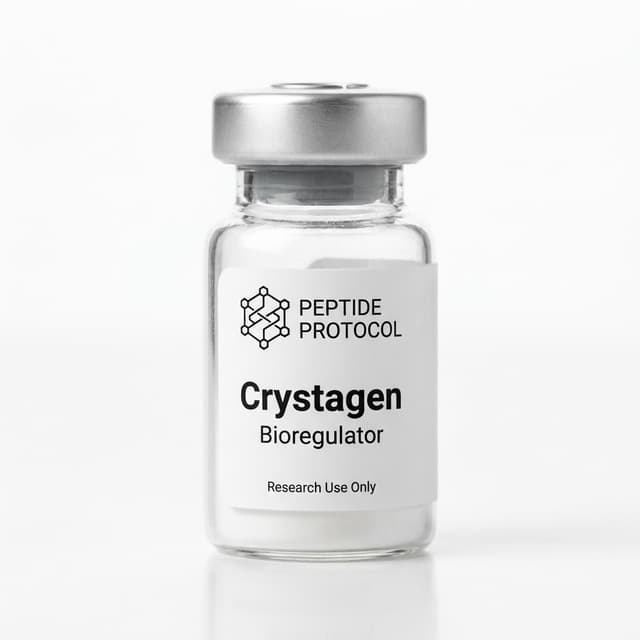
Crystagen
Quick Reference
- Default Dose
- 5 mg
- Frequency
- 2x/week
- Timing
- AM
- Dilution
- 2 mL
Storage
- Lyophilized
- -20°C
- Reconstituted
- 2-8°C
For Practitioners
Interested in offering research-grade compounds through your practice? Learn about our affiliate program for qualified practitioners.
Find a ProviderPractitioner Information