
CJC-1295 and Ipamorelin are designed for clients who want measurable performance, recovery, and longevity benefits—without crossing the line into hormone replacement or system shutdown. This is not synthetic HGH and it’s not a short-term hack. It’s a disciplined, physiology-first approach that restores the body’s own growth hormone signaling, which naturally declines with age, stress, poor sleep, and overtraining. CJC-1295 works upstream at the pituitary level, enhancing the quality, duration, and consistency of natural GH release, while Ipamorelin acts as a precision trigger—stimulating GH without the cortisol spikes, prolactin elevation, or hunger issues associated with older compounds. Together, they create smoother, more youthful GH pulses that the body actually knows how to use. From a client experience standpoint, this shows up where it matters: deeper, more restorative sleep; faster recovery between workouts or long workdays; improved fat metabolism; better skin and tissue quality; and a noticeable improvement in overall resilience. There’s no suppression of natural production, no dependency risk, and no hormonal rollercoaster—making it appropriate for long-term use and scalable protocols. For many clients, this stack becomes the foundation layer they build everything else on, because it improves how the body repairs, adapts, and recovers across the board. In short, this is growth hormone optimization for adults who play the long game—subtle, sustainable, and designed to deliver compounding returns over time.
Research Background
GH secretagogue blend for optimal GH pulses: CJC-1295 and Ipamorelin are best understood as growth-hormone secretagogues that restore signal quality, not brute-force hormone replacement. CJC-1295 is a GHRH analog that stimulates the pituitary to release endogenous growth hormone by amplifying natural pulsatility; versions with DAC extend half-life, while no-DAC variants preserve tighter, physiologic spikes. Ipamorelin is a selective ghrelin (GHS-R) agonist that triggers GH release without the usual collateral damage—minimal cortisol, prolactin, or aldosterone elevation. Mechanistically, they complement each other: CJC provides the upstream “permission” signal, Ipamorelin provides the clean trigger. The result is higher-quality GH pulses, improved IGF-1 signaling downstream, and support for recovery, sleep architecture, fat metabolism, and tissue repair—without pituitary shutdown or the side-effect profile of exogenous HGH. Translation: classic endocrinology, modern execution. You’re upgrading the control system, not flooring the accelerator.
| Level | Dose | Frequency | Notes |
|---|---|---|---|
| Beginner | 250 | 5 days on, 2 off | — |
| Intermediate | 300-500 | 5 days on, 2 off | — |
| Advanced | 300-500 2x/day | 5 days on, 2 off | — |
| Maximum | 250-500 3x/day | 5 days on, 2 off | — |
Blend Dosing Approach
This **pre-combined formulation** provides a fixed 1:1 ratio of CJC-1295 (No DAC) and Ipamorelin, simplifying administration by eliminating the need to measure and mix separate peptides. The **fixed-ratio blend** is designed based on commonly researched dosing relationships between these compounds in the scientific literature. Since the peptides are pre-mixed at specific concentrations, dosing becomes **volume-based** rather than requiring individual peptide calculations. The **synchronized pharmacokinetics** of both compounds, with their similar onset and duration profiles, support once-daily administration timing. Most research suggests optimal timing is in the evening to align with natural **circadian GH patterns**, though specific timing may vary based on research objectives. The pre-combined format ensures **consistent ratios** between doses and reduces preparation complexity while maintaining the complementary effects of both peptides in each administration.
Per-Component Breakdown
Synergy Rationale
The CJC-1295 (No DAC) and Ipamorelin combination represents a scientifically rational approach to **growth hormone optimization** by targeting complementary pathways in the GH release system. CJC-1295 functions as a **GHRH analog** that activates the natural growth hormone-releasing hormone pathway, while Ipamorelin acts as a **ghrelin receptor agonist** that stimulates GH release through the body's hunger-signaling system. This dual-pathway approach provides more comprehensive **pituitary stimulation** than either peptide alone. Both peptides preserve **physiological pulsatility** rather than causing sustained GH elevation, making them highly compatible for combination use. The **no-DAC version of CJC-1295** was specifically chosen for this blend because its shorter duration of action aligns well with Ipamorelin's pharmacokinetic profile, allowing both peptides to work synergistically within similar timeframes. This combination theoretically provides broader **receptor activation** across multiple GH-stimulating pathways while maintaining the natural feedback mechanisms that regulate healthy growth hormone homeostasis.
Combined Mechanism
At the cellular level, this blend activates **dual signaling cascades** that converge on growth hormone release from pituitary somatotrophs. CJC-1295 binds to **GHRH receptors** and activates the **adenylyl cyclase-cAMP-PKA pathway**, leading to CREB phosphorylation and increased GH gene transcription. Simultaneously, Ipamorelin activates **ghrelin receptors (GHSR-1a)** through **Gq/11 protein coupling**, triggering **phospholipase C activation** and generating IP3 and DAG, which mobilize intracellular calcium and activate protein kinase C. These parallel pathways create a more robust stimulus for **GH secretion** through both transcriptional upregulation and enhanced vesicle exocytosis. The **complementary receptor targets** mean that the combination can potentially overcome individual pathway limitations or receptor desensitization that might occur with single-peptide approaches. Both pathways ultimately converge on **IGF-1 production** in the liver, potentially creating additive effects on downstream anabolic processes. The synchronized **pulsatile release pattern** from both peptides may enhance the physiological GH response while maintaining natural feedback regulation through **somatostatin modulation**. This dual-pathway activation theoretically provides more consistent and comprehensive growth hormone stimulation than either mechanism alone.
Research Context
While extensive research exists on CJC-1295 and Ipamorelin individually, **direct combination studies** of these specific peptides together remain limited in the published literature. However, research on **GHRH and ghrelin receptor co-stimulation** provides theoretical support for combining these complementary pathways. Studies have shown that **dual-pathway GH stimulation** can produce enhanced responses compared to single-agent approaches, though most published work focuses on other peptide combinations or pharmaceutical compounds. The scientific rationale for this blend is based on **mechanistic complementarity** rather than direct combination clinical trials. Current research gaps include optimal dosing ratios, long-term safety profiles of the combination, and comprehensive efficacy data comparing the blend to individual peptides. The combination represents a **research-supported theoretical approach** to GH optimization, but investigators should be aware that specific combination data is still evolving in the scientific literature.
Research Use Only: All compounds discussed on this page are intended for laboratory research purposes only. Not for human consumption. All research should be conducted in compliance with institutional guidelines and applicable regulations. Consult qualified healthcare professionals before making any decisions regarding compound research or use.
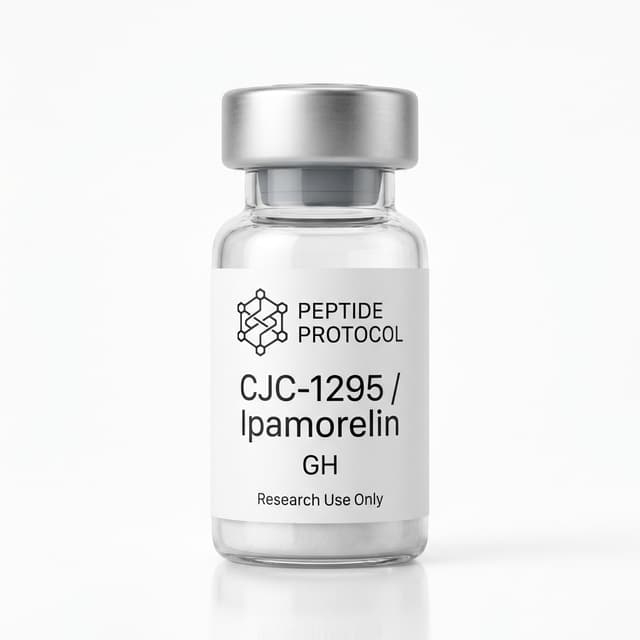
CJC-1295 / Ipamorelin
Quick Reference
- Default Dose
- 250
- Frequency
- 5 days on, 2 off
- Timing
- AM
- Dilution
- 2 mL
For Practitioners
Interested in offering research-grade compounds through your practice? Learn about our affiliate program for qualified practitioners.
Find a ProviderPractitioner Information