
GH pulses
GHRH analog for pulsatile GH release
| Level | Dose | Frequency | Notes |
|---|---|---|---|
| Beginner | 200 mcg | 5 days on, 2 off | — |
| Intermediate | 300 mcg | 5 days on, 2 off | — |
| Advanced | 250 mcg 2x/day | 5 days on, 2 off | — |
| Maximum | 500 mg 2-3x/day | 5 days on, 2 off | 3x/day |
Pharmacodynamics
CJC-1295 (No DAC) functions as a synthetic analog of growth hormone-releasing hormone (GHRH), specifically designed to bind and activate GHRH receptors located on somatotroph cells within the anterior pituitary gland. Upon receptor binding, CJC-1295 triggers the activation of adenylyl cyclase, leading to increased cyclic adenosine monophosphate (cAMP) levels within the target cells. This elevation in cAMP activates protein kinase A (PKA), which subsequently phosphorylates and activates transcription factors such as CREB (cAMP response element-binding protein). The activated transcription machinery increases the synthesis and secretion of growth hormone from pituitary somatotrophs. The no-DAC version of CJC-1295 preserves the physiological pulsatile nature of GH release, which is crucial for optimal downstream effects. Following GH secretion, the hormone travels to the liver and peripheral tissues, where it stimulates the production of insulin-like growth factor-1 (IGF-1) through JAK-STAT signaling pathways. IGF-1 then mediates many of the anabolic effects associated with GH, including protein synthesis, lipolysis, and cellular repair processes. The pulsatile nature of GH release induced by CJC-1295 (No DAC) is important because continuous GH exposure can lead to receptor desensitization and potentially adverse metabolic effects. The short duration of action maintains the natural circadian rhythm of GH secretion, which typically peaks during deep sleep phases.
Pharmacokinetics
CJC-1295 (No DAC) is typically administered via subcutaneous injection due to its peptide nature, which would be degraded by gastrointestinal enzymes if taken orally. Following subcutaneous administration, the peptide is absorbed into systemic circulation with peak plasma concentrations typically reached within 30-60 minutes. The absence of the drug affinity complex (DAC) results in a relatively short plasma half-life of approximately 30 minutes, which is significantly shorter than the DAC version. This rapid clearance is primarily due to enzymatic degradation by dipeptidyl peptidase-4 (DPP-4) and other proteases, as well as renal filtration. The peptide distributes throughout the body via the circulatory system, with its primary site of action being the anterior pituitary gland. Unlike the DAC version, CJC-1295 (No DAC) does not bind extensively to serum albumin, contributing to its shorter duration of action but also preserving more physiological GH release patterns. Elimination occurs through both hepatic metabolism and renal excretion, with the majority of the peptide being cleared within a few hours of administration. This pharmacokinetic profile necessitates more frequent dosing compared to the DAC version but offers the advantage of maintaining natural GH pulsatility.
Clinical Data
Research on CJC-1295 has primarily focused on preclinical studies and limited human trials. Early animal studies demonstrated the peptide's ability to stimulate GH release and increase IGF-1 levels while maintaining physiological pulsatile patterns. In rodent models, CJC-1295 administration resulted in increased lean body mass, improved bone density, and enhanced recovery from physical stress. Limited human studies have shown that CJC-1295 can effectively stimulate GH release in healthy adults, with the no-DAC version producing more physiological pulsatile patterns compared to the sustained elevation seen with the DAC version. However, comprehensive phase II and III clinical trials are lacking, and the peptide is not approved by major regulatory agencies such as the FDA or EMA for therapeutic use. Current regulatory status classifies CJC-1295 as an investigational compound, with ongoing research focusing on its potential applications in age-related GH deficiency, muscle wasting conditions, and metabolic disorders. Safety data remains limited, particularly regarding long-term use, though short-term studies suggest a relatively favorable safety profile when used appropriately. Researchers continue to investigate optimal dosing protocols, potential side effects, and therapeutic applications, with particular interest in the no-DAC version's ability to preserve natural GH physiology.
References
- Growth hormone-releasing peptide-6 and growth hormone-releasing hormone: effects on the growth hormone-insulin-like growth factor-I axis in normal and diabetic rats — Pong SS et al., Metabolism (1996)
- Prolonged stimulation of growth hormone release by CJC-1295, a long-acting analog of growth hormone-releasing hormone in healthy adults — Teichman SL et al., Journal of Clinical Endocrinology and Metabolism (2006)
- Growth hormone releasing hormone and its analogues: structure-activity relationships and therapeutic applications — Schally AV et al., Current Medicinal Chemistry (2013)
Research Use Only: All compounds discussed on this page are intended for laboratory research purposes only. Not for human consumption. All research should be conducted in compliance with institutional guidelines and applicable regulations. Consult qualified healthcare professionals before making any decisions regarding compound research or use.
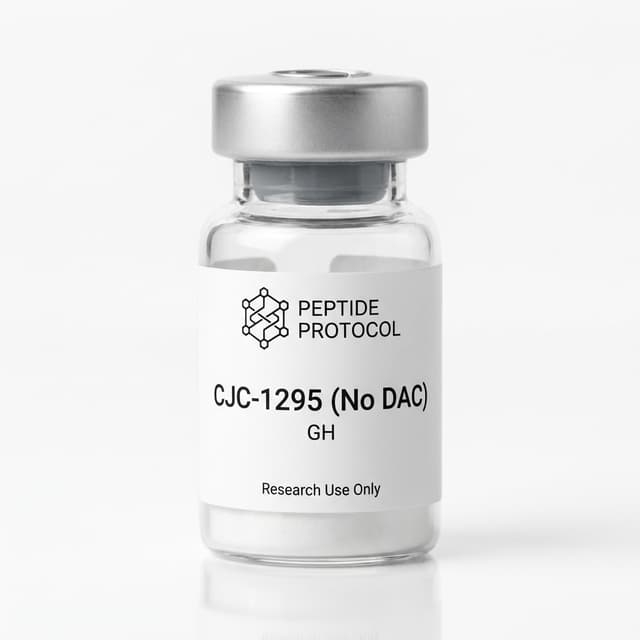
CJC-1295 (No DAC)
Quick Reference
- Default Dose
- 200 mcg
- Frequency
- 5 days on, 2 off
- Timing
- AM
- Dilution
- 2 mL
Storage
- Lyophilized
- -20°C
- Reconstituted
- 2-8°C
For Practitioners
Interested in offering research-grade compounds through your practice? Learn about our affiliate program for qualified practitioners.
Find a ProviderPractitioner Information