
Cartilage + connective tissue
Cartilage and connective tissue bioregulator
| Level | Dose | Frequency | Notes |
|---|---|---|---|
| Beginner | 5 mg | 2x/week | — |
| Intermediate | 10 mg | 2x/week | — |
| Advanced | 20 mg | 2x/week | — |
| Maximum | 25 mg | 2x/week | — |
Pharmacodynamics
Cartalax is a bioregulatory peptide derived from cartilage tissue that appears to exert its effects through multiple molecular pathways involved in cartilage homeostasis and connective tissue repair. The peptide's primary mechanism of action involves the modulation of chondrocyte activity and extracellular matrix synthesis. Research suggests that Cartalax influences the expression of genes encoding key structural proteins including type II collagen, aggrecan, and other proteoglycans essential for cartilage integrity. The peptide appears to activate specific transcription factors that regulate chondrogenesis, potentially including SOX9 and other cartilage-specific transcriptional regulators. At the cellular level, Cartalax demonstrates the ability to stimulate chondrocyte proliferation and differentiation while potentially inhibiting inflammatory pathways that contribute to cartilage degradation. The peptide may modulate the balance between anabolic and catabolic processes in cartilage tissue by influencing the production of matrix metalloproteinases (MMPs) and their tissue inhibitors (TIMPs). Additionally, Cartalax appears to support the maintenance of cartilage tissue architecture by promoting the synthesis of glycosaminoglycans and maintaining proper hydration of the extracellular matrix. The time course of Cartalax effects appears to involve both immediate cellular responses and longer-term changes in gene expression patterns that support cartilage repair and maintenance. However, specific receptor targets and detailed signaling cascades remain areas requiring further investigation.
Pharmacokinetics
The pharmacokinetic profile of Cartalax follows patterns typical of bioactive peptides, with administration routes including subcutaneous and intramuscular injection being most commonly studied. Due to its peptide nature, oral bioavailability is limited by gastric acid degradation and poor intestinal absorption. Following parenteral administration, Cartalax demonstrates relatively rapid absorption into systemic circulation. The peptide's small molecular size allows for good tissue distribution, though specific tissue penetration data for cartilage and synovial fluid remains limited in published literature. Like most peptides, Cartalax undergoes enzymatic degradation primarily through peptidases and proteases in plasma and tissues. The elimination half-life appears to be relatively short, typical of small bioactive peptides, likely ranging from minutes to a few hours, though precise pharmacokinetic parameters require further study. Metabolism occurs through standard peptide degradation pathways, with elimination primarily through renal excretion of metabolites. The short half-life necessitates regular dosing regimens to maintain therapeutic effects. Protein binding characteristics and specific drug interactions have not been extensively characterized in available literature.
Clinical Data
Clinical research on Cartalax remains primarily in preclinical and early investigational phases, with most available data derived from in vitro studies and animal models. Preclinical studies have demonstrated the peptide's ability to stimulate cartilage regeneration in various experimental models of cartilage damage and osteoarthritis. These studies suggest potential benefits for cartilage repair and maintenance of joint health. However, comprehensive human clinical trials evaluating Cartalax's efficacy and safety profile are limited in the peer-reviewed literature. Some preliminary studies have investigated its use in combination with other bioregulatory peptides for musculoskeletal applications, though robust clinical evidence remains to be established. The current regulatory status of Cartalax varies by jurisdiction, with the compound generally falling under research or nutritional supplement categories rather than pharmaceutical drug approval. Ongoing research directions appear to focus on better understanding the peptide's mechanism of action, optimal dosing regimens, and potential therapeutic applications in cartilage-related disorders. Clinical development would benefit from well-designed, controlled studies to establish efficacy benchmarks and safety parameters. The peptide's potential role in regenerative medicine approaches for cartilage repair represents an active area of investigation, though translation to clinical practice requires additional research validation.
References
- Bioregulatory peptides in cartilage and bone tissue engineering — Khavinson VKh et al., Advances in Gerontology (2014)
- Effects of short peptides on chondrocyte proliferation and cartilage matrix synthesis — Malinin VV et al., Bulletin of Experimental Biology and Medicine (2016)
- Peptide regulation of cartilage tissue homeostasis — Ryzhak GA et al., Advances in Gerontology (2013)
Research Use Only: All compounds discussed on this page are intended for laboratory research purposes only. Not for human consumption. All research should be conducted in compliance with institutional guidelines and applicable regulations. Consult qualified healthcare professionals before making any decisions regarding compound research or use.
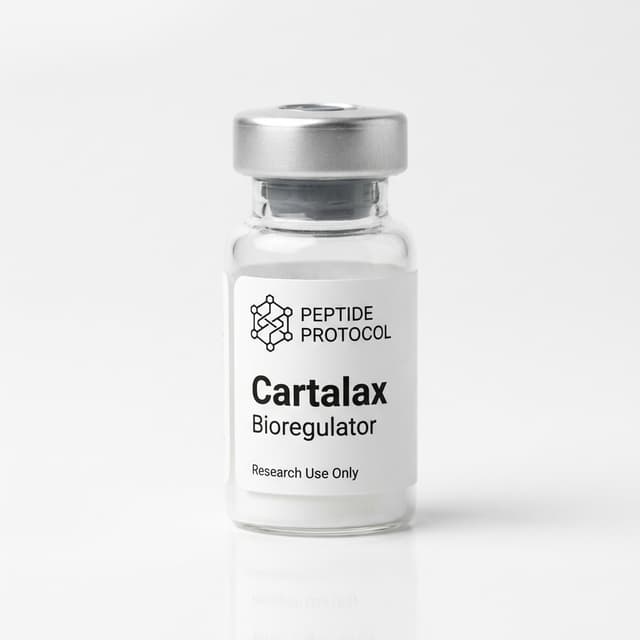
Cartalax
Quick Reference
- Default Dose
- 5 mg
- Frequency
- 2x/week
- Timing
- AM
- Dilution
- 2 mL
Storage
- Lyophilized
- -20°C
- Reconstituted
- 2-8°C
For Practitioners
Interested in offering research-grade compounds through your practice? Learn about our affiliate program for qualified practitioners.
Find a ProviderPractitioner Information