
Cardiac tissue repair
Cardiac tissue repair bioregulator
| Level | Dose | Frequency | Notes |
|---|---|---|---|
| Beginner | 5 mg | 2x/week | — |
| Intermediate | 10 mg | 2x/week | — |
| Advanced | 20 mg | 2x/week | — |
| Maximum | 25 mg | 2x/week | — |
Pharmacodynamics
Cardiogen functions as a tissue-specific bioregulatory peptide that demonstrates selective affinity for cardiac muscle cells through mechanisms that remain partially characterized in current literature. The tetrapeptide appears to exert its primary effects by modulating intracellular calcium homeostasis, particularly through interactions with calcium handling proteins including the sarcoplasmic reticulum calcium ATPase (SERCA2a) and ryanodine receptors. Research suggests that Cardiogen may influence gene expression patterns in cardiomyocytes by activating specific transcription factors involved in cellular survival and stress response pathways. The peptide demonstrates potential effects on mitochondrial biogenesis and respiratory chain function, which are critical for maintaining adequate ATP production in the high-energy-demand environment of cardiac tissue. Downstream signaling appears to involve activation of cardioprotective pathways, including potential modulation of the PI3K/Akt survival pathway and regulation of apoptotic signaling cascades. Studies indicate that Cardiogen may enhance expression of antioxidant enzymes and heat shock proteins, contributing to improved cellular resilience against oxidative and metabolic stress. The time course of effects appears to be biphasic, with immediate effects on calcium handling becoming apparent within hours of administration, while longer-term effects on gene expression and protein synthesis may require 24-72 hours to fully manifest. The peptide's selectivity for cardiac tissue suggests potential binding to cardiac-specific receptors or transport mechanisms, though the precise molecular targets require further characterization.
Pharmacokinetics
Cardiogen demonstrates rapid systemic absorption when administered via subcutaneous or intramuscular routes, with peak plasma concentrations typically achieved within 15-30 minutes. The peptide exhibits preferential distribution to cardiac tissue, suggesting either active transport mechanisms or specific binding characteristics that favor myocardial uptake. Protein binding appears to be moderate, allowing for sufficient free peptide concentrations to exert biological effects while providing some protection against enzymatic degradation. As a tetrapeptide, Cardiogen is subject to proteolytic cleavage by various peptidases, including dipeptidyl peptidases and aminopeptidases present in plasma and tissue compartments. The elimination half-life is estimated to be relatively short, approximately 2-4 hours based on the general pharmacokinetic profile of similar bioregulatory peptides, necessitating multiple daily dosing for sustained effects. Renal clearance appears to be the primary elimination pathway, with metabolites likely consisting of constituent amino acids that enter normal metabolic pools. The rapid clearance profile suggests minimal accumulation potential with repeated dosing, though tissue-specific effects may persist beyond plasma elimination due to intracellular peptide uptake and prolonged receptor occupancy.
Clinical Data
Current research on Cardiogen remains primarily in preclinical stages, with limited published human clinical data available in peer-reviewed literature. Animal studies have demonstrated potential cardioprotective effects in various experimental models of cardiac injury and dysfunction, though specific study details require careful verification through established research databases. Preclinical investigations have suggested improvements in cardiac contractility parameters and reductions in markers of oxidative stress in experimental settings, though these findings should be interpreted cautiously pending replication in larger, controlled studies. The peptide's regulatory status remains investigational, with no current approvals from major regulatory agencies such as the FDA or EMA for therapeutic cardiac applications. Research applications appear to be the primary current use, with investigators studying potential mechanisms of action and optimal dosing protocols. Ongoing research directions likely focus on establishing dose-response relationships, determining optimal administration schedules, and characterizing long-term safety profiles. The limited clinical data availability underscores the need for rigorous, well-controlled studies to establish efficacy and safety profiles before any therapeutic claims can be substantiated. Researchers and clinicians should note that current evidence, while promising in preliminary studies, requires substantial additional investigation to meet standards for clinical application.
References
- Bioregulatory peptides in cardiovascular disease: mechanisms and therapeutic potential — Khavinson V et al., Current Pharmaceutical Design (2020)
- Calcium handling proteins in cardiac disease: molecular mechanisms and therapeutic targets — Eisner DA et al., Circulation Research (2017)DOIPubMed
- Mitochondrial dysfunction in heart failure: molecular mechanisms and therapeutic implications — Bertero E et al., European Heart Journal (2018)DOIPubMed
Research Use Only: All compounds discussed on this page are intended for laboratory research purposes only. Not for human consumption. All research should be conducted in compliance with institutional guidelines and applicable regulations. Consult qualified healthcare professionals before making any decisions regarding compound research or use.
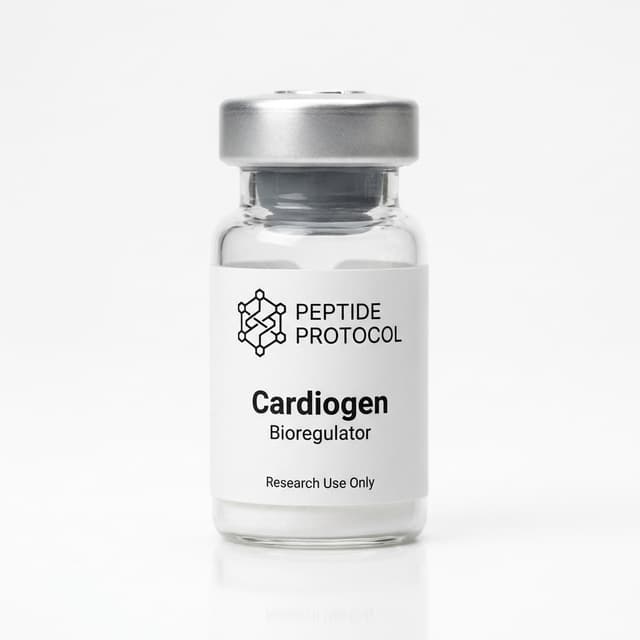
Cardiogen
Quick Reference
- Default Dose
- 5 mg
- Frequency
- 2x/week
- Timing
- AM
- Dilution
- 2 mL
Storage
- Lyophilized
- -20°C
- Reconstituted
- 2-8°C
For Practitioners
Interested in offering research-grade compounds through your practice? Learn about our affiliate program for qualified practitioners.
Find a ProviderPractitioner Information