
Combined Cagrilintide + Semaglutide blend for dual mechanism appetite control
| Level | Dose | Frequency | Notes |
|---|---|---|---|
| Beginner | 0.25 mg | Weekly | — |
| Intermediate | 0.5 mg | Weekly | — |
| Advanced | 1 mg | Weekly | — |
| Maximum | 2-3 mg | Weekly | — |
Blend Dosing Approach
CagriSema is formulated as a **fixed-ratio blend** containing 5mg each of cagrilintide and semaglutide, eliminating the need for separate injections or dose calculations. This **pre-combined format** simplifies administration by providing both peptides in a single weekly injection, leveraging the similar **pharmacokinetic profiles** of both compounds (100-160 hour half-life for cagrilintide, 165-184 hour half-life for semaglutide). The fixed combination ensures consistent **peptide ratios** and may optimize the potential synergistic effects between the two pathways. Since the blend uses predetermined concentrations, dosing is **volume-based** rather than requiring individual peptide calculations. The **once-weekly injection schedule** aligns with both peptides' extended half-lives, providing convenient dosing that may improve compliance compared to daily appetite management protocols.
Per-Component Breakdown
Synergy Rationale
CagriSema combines two complementary hormone pathways that naturally work together in appetite regulation. **Cagrilintide** targets the **amylin receptor system**, providing what researchers call a "hunger kill switch" through direct brainstem appetite centers, while **semaglutide** activates the **GLP-1 pathway** that governs the gut-brain communication network. This dual-hormone approach addresses appetite suppression through both **central nervous system signaling** and **peripheral satiety mechanisms**. The scientific rationale stems from understanding that natural appetite control involves multiple redundant pathways - amylin and GLP-1 are both released after meals and work synergistically to promote fullness. By combining these pathways pharmacologically, the blend may achieve more comprehensive appetite suppression than either peptide alone. Both compounds share similar **weekly dosing schedules** and complementary mechanisms including **delayed gastric emptying**, **enhanced satiety signaling**, and **appetite center modulation**, making them an ideal pairing for sustained weight management research.
Combined Mechanism
At the pathway level, CagriSema creates a **dual-receptor activation system** targeting both **amylin and GLP-1 receptors** simultaneously. Cagrilintide binds to **amylin receptors** (CTR/RAMP complexes) primarily in the **area postrema and nucleus tractus solitarius**, creating direct brainstem appetite suppression, while semaglutide activates **GLP-1 receptors** in the **hypothalamic arcuate and paraventricular nuclei** as well as peripheral tissues. Both pathways converge on **cAMP signaling cascades** and **CREB phosphorylation**, potentially creating additive or synergistic effects on appetite-regulating gene expression. The combination provides overlapping mechanisms including **delayed gastric emptying** through different receptor systems, **enhanced vagal nerve signaling** from gut to brain, and **prolonged satiation** through complementary pathways. While cagrilintide acts as a direct "hunger kill switch" through brainstem receptors, semaglutide provides broader **metabolic regulation** including **glucose-dependent insulin response** and **gut-brain axis communication**. This dual approach may result in more sustained appetite suppression with potentially reduced individual peptide doses needed for therapeutic effect, though direct combination research remains limited.
Research Context
While extensive clinical research exists for both individual peptides, **direct combination studies** of cagrilintide with semaglutide remain limited in published literature. However, the scientific rationale is supported by research showing **natural co-secretion patterns** of amylin and incretin hormones, and studies demonstrating that **dual-hormone approaches** in metabolism can provide enhanced therapeutic outcomes. Cagrilintide clinical trials have specifically evaluated combinations with **GLP-1 receptor agonists**, suggesting potential synergistic effects, though detailed combination pharmacokinetics and optimal dosing ratios require further investigation. The research gap exists primarily in **long-term safety data** for the specific combination and **dose-optimization studies** for the fixed-ratio approach. Current understanding suggests the combination is pharmacologically rational based on **complementary mechanisms of action**, but comprehensive combination-specific clinical trials would strengthen the evidence base for this dual-peptide approach to appetite regulation.
Research Use Only: All compounds discussed on this page are intended for laboratory research purposes only. Not for human consumption. All research should be conducted in compliance with institutional guidelines and applicable regulations. Consult qualified healthcare professionals before making any decisions regarding compound research or use.
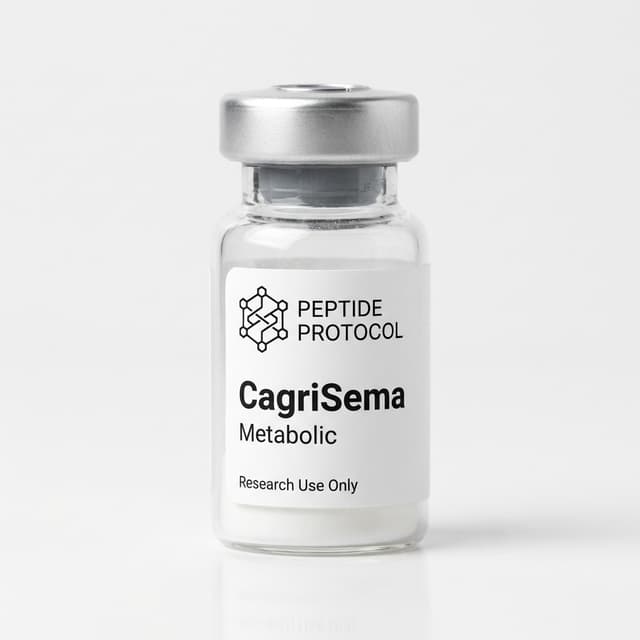
CagriSema
Quick Reference
- Default Dose
- 0.25 mg
- Frequency
- Weekly
- Timing
- —
- Dilution
- 2 mL
For Practitioners
Interested in offering research-grade compounds through your practice? Learn about our affiliate program for qualified practitioners.
Find a ProviderPractitioner Information