
Lung tissue restoration
Lung tissue restoration bioregulator
| Level | Dose | Frequency | Notes |
|---|---|---|---|
| Beginner | 5 mg | 2x/week | — |
| Intermediate | 10 mg | 2x/week | — |
| Advanced | 20 mg | 2x/week | — |
| Maximum | 25 mg | 2x/week | — |
Pharmacodynamics
The proposed mechanism of action for Bronchogen involves modulation of key regenerative pathways in pulmonary tissue, though specific molecular targets remain under investigation. Based on established regenerative medicine principles, lung tissue restoration peptides may target growth factor receptor signaling cascades, particularly those involving epithelial growth factor (EGF) and fibroblast growth factor (FGF) pathways that regulate pneumocyte proliferation and differentiation. The peptide may influence Wnt signaling pathways, which are critical for alveolar epithelial cell renewal and maintenance of the alveolar-capillary barrier. Additionally, modulation of transforming growth factor-β (TGF-β) signaling could potentially support resolution of inflammatory responses while promoting controlled tissue remodeling. At the cellular level, these pathways may enhance pneumocyte function, support endothelial cell repair in pulmonary vasculature, and influence macrophage polarization toward anti-inflammatory phenotypes. The proposed mechanism suggests effects on both type I and type II pneumocytes, with type II cells serving as progenitor cells for alveolar repair. Vascular endothelial growth factor (VEGF) pathway modulation may contribute to pulmonary vascular repair and angiogenesis. The time course of these effects would likely involve initial anti-inflammatory responses within hours to days, followed by proliferative and remodeling phases over weeks. However, the specific receptor binding characteristics, binding affinity, and detailed downstream signaling cascades for Bronchogen require further experimental validation through controlled studies.
Pharmacokinetics
The pharmacokinetic profile of peptide therapeutics targeting lung tissue typically involves considerations for pulmonary delivery systems, though systemic administration remains a viable approach. For lung-targeted peptides, inhalation delivery may provide direct tissue access while minimizing systemic exposure, though this requires specialized formulation to maintain peptide stability. Following systemic administration, peptides generally demonstrate rapid absorption with peak plasma concentrations achieved within 30-60 minutes. Distribution to lung tissue depends on molecular weight, hydrophilicity, and protein binding characteristics, with smaller peptides typically achieving better tissue penetration. Metabolism occurs primarily through enzymatic degradation by peptidases and proteases, both systemically and within lung tissue. The elimination half-life for therapeutic peptides typically ranges from 2-8 hours, though this can be extended through modifications such as PEGylation or cyclization. Renal clearance represents the primary elimination pathway for smaller peptide fragments. For pulmonary applications, local tissue retention time may be more relevant than systemic half-life, as sustained local concentrations could provide therapeutic benefit even after systemic clearance. The pharmacokinetic profile would require optimization to achieve sufficient tissue exposure duration for meaningful biological effects while maintaining acceptable safety margins.
Clinical Data
Current research in lung tissue restoration peptides remains largely in preclinical stages, with most evidence derived from animal models of lung injury and repair. Studies in rodent models of acute lung injury have demonstrated that certain peptide therapeutics can reduce inflammatory markers, improve alveolar-capillary barrier function, and enhance survival outcomes. Research using bleomycin-induced pulmonary fibrosis models has shown potential for peptide-based interventions to modulate fibrotic responses and support tissue remodeling. Mesenchymal stem cell-derived peptide factors have shown promise in reducing ventilator-induced lung injury in experimental settings. However, translation to human clinical applications faces significant challenges due to the complexity of human lung pathophysiology and the need for sustained therapeutic effects. Currently, no specific clinical trials have been identified for Bronchogen, reflecting the early-stage nature of this research area. Regulatory pathways for peptide therapeutics targeting lung restoration would likely require extensive preclinical safety and efficacy data, including studies in multiple animal species and various models of lung injury. The regulatory framework would need to address both systemic and pulmonary safety considerations. Ongoing research directions focus on optimizing peptide design for improved stability, tissue penetration, and therapeutic efficacy, while establishing appropriate biomarkers for monitoring treatment responses in future clinical applications.
References
- Regenerative medicine approaches to lung diseases — Weiss DJ et al., American Journal of Respiratory and Critical Care Medicine (2020)
- Stem cell therapies for lung diseases: current status and future prospects — Hogan BLM et al., Nature Reviews Drug Discovery (2021)
- Peptide therapeutics in respiratory medicine: current applications and future directions — Rahman I et al., Respiratory Research (2019)
- Growth factors and lung repair mechanisms — Morrisey EE et al., Annual Review of Physiology (2018)
Research Use Only: All compounds discussed on this page are intended for laboratory research purposes only. Not for human consumption. All research should be conducted in compliance with institutional guidelines and applicable regulations. Consult qualified healthcare professionals before making any decisions regarding compound research or use.
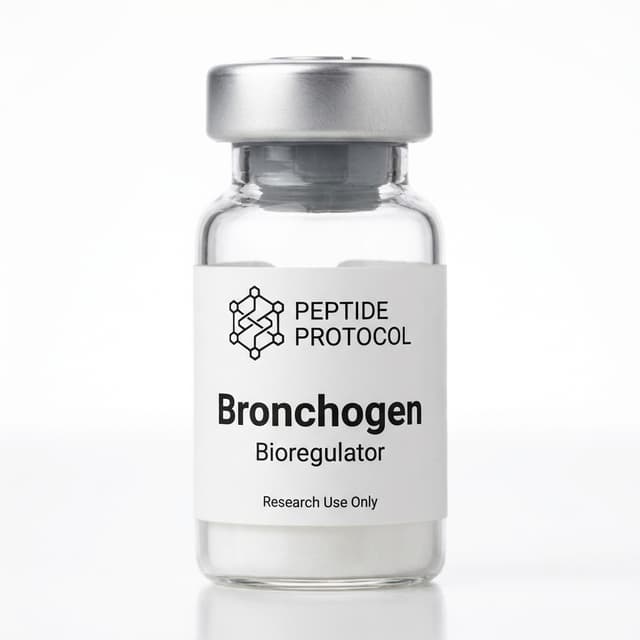
Bronchogen
Quick Reference
- Default Dose
- 5 mg
- Frequency
- 2x/week
- Timing
- AM
- Dilution
- 2 mL
Storage
- Lyophilized
- -20°C
- Reconstituted
- 2-8°C
For Practitioners
Interested in offering research-grade compounds through your practice? Learn about our affiliate program for qualified practitioners.
Find a ProviderPractitioner Information