
Healing blend for comprehensive tissue repair
Research Background
BPC-157 and TB-500 sit in the “repair signaling” lane, not the hormone lane. BPC-157 (a gastric-derived peptide fragment) has been studied extensively in animal and cellular models for its ability to accelerate soft-tissue healing, protect endothelial function, up-regulate angiogenesis (via VEGF/NO pathways), stabilize nitric oxide signaling, and reduce inflammatory cascades without blunt immunosuppression. It appears to enhance fibroblast migration, collagen organization, and tendon-to-bone integration—basically improving how tissue heals, not just how fast. TB-500 (the synthetic active fragment of thymosin beta-4) operates at a higher, systemic level: mobilizing actin, supporting cell migration, reducing fibrosis, and improving muscle, tendon, and fascia regeneration. It’s been studied in wound healing, ischemic injury, cardiac repair, and muscle recovery models. Together, the pairing makes sense: BPC-157 handles precision repair and vascular integrity; TB-500 handles global tissue remodeling and recovery. Old-school biology, modern application. Think scaffolding + construction crew—not steroids, not HGH, just smarter healing signals.
| Level | Dose | Frequency | Notes |
|---|---|---|---|
| Beginner | 500 mcg | Daily | — |
| Intermediate | 1 mg | Daily | — |
| Advanced | 1.5 mg 2x/day | Daily | — |
| Maximum | 2 mg 1-3x/day | Daily | — |
Blend Dosing Approach
This **pre-combined formulation** delivers both peptides in a fixed ratio, eliminating the need for separate reconstitution and injection protocols. The **volume-based dosing** approach means researchers select their injection volume based on the desired peptide amounts, with both compounds administered simultaneously in consistent proportions. This **streamlined administration** reduces injection frequency and simplifies research protocols compared to separate peptide regimens. The fixed-ratio format ensures **consistent compound ratios** across doses, which may be important for maintaining any potential synergistic effects between the peptides. **Dosing frequency** considerations should account for both peptides' relatively short half-lives, typically supporting multiple daily administrations. The pre-combined format also reduces handling complexity and potential contamination risks associated with preparing multiple separate solutions.
Per-Component Breakdown
Synergy Rationale
The BPC-157/TB-500 combination represents a **complementary approach** to tissue healing that addresses multiple phases of the repair process simultaneously. BPC-157's **systemic healing properties** focus on vascular repair, angiogenesis, and anti-inflammatory modulation, while TB-500's **actin-binding mechanism** enhances cellular migration and tissue regeneration at the cellular level. This pairing creates a **dual-pathway strategy** where BPC-157 establishes optimal healing conditions through improved blood flow and reduced inflammation, while TB-500 facilitates the actual cellular movements necessary for tissue repair. Both peptides share **overlapping angiogenic properties** through VEGF upregulation, potentially creating amplified blood vessel formation. The combination also addresses different temporal aspects of healing - BPC-157 provides immediate anti-inflammatory effects and sustained tissue protection, while TB-500's **cytoskeletal remodeling** supports the longer-term cellular reorganization required for complete tissue restoration. This scientific rationale suggests that combining these mechanisms may provide more comprehensive healing support than either peptide alone.
Combined Mechanism
At the pathway level, BPC-157 and TB-500 create **convergent healing mechanisms** that complement each other's therapeutic effects. Both peptides independently upregulate **VEGF signaling**, potentially creating enhanced angiogenic responses that exceed what either compound achieves alone. BPC-157's **nitric oxide pathway modulation** improves vascular function and blood flow, creating an optimal environment for TB-500's **actin-mediated cell migration** to deliver repair cells efficiently to injury sites. The anti-inflammatory profiles work synergistically - BPC-157 reduces **pro-inflammatory cytokines** like TNF-α and IL-6, while TB-500 modulates inflammatory responses to support tissue remodeling without excessive scarring. **Extracellular matrix remodeling** represents another convergent pathway, with BPC-157 enhancing **collagen synthesis** through fibroblast activation, while TB-500 promotes optimal collagen organization through its cytoskeletal effects. The **growth factor signaling cascades** activated by BPC-157, including BMP pathways and BDNF modulation, may enhance TB-500's cellular migration and proliferation effects. This multi-pathway convergence theoretically creates a comprehensive healing environment that addresses vascular repair, cellular migration, matrix remodeling, and inflammatory resolution simultaneously.
Research Context
Direct research on the **BPC-157/TB-500 combination** is currently limited in peer-reviewed literature, with most studies examining these peptides individually rather than as a combined therapy. However, research on similar **multi-peptide healing approaches** in regenerative medicine suggests that combining peptides with complementary mechanisms may enhance overall therapeutic outcomes. Both compounds have **extensive individual preclinical data** supporting their healing properties, and their **overlapping angiogenic and anti-inflammatory pathways** provide scientific rationale for combination use. Current **knowledge gaps** include optimal ratio determination, potential pharmacokinetic interactions, and direct comparative studies against individual peptide treatments. The combination represents an **emerging area of interest** in peptide-based healing research, though controlled studies specifically evaluating this blend's synergistic potential remain needed to fully validate the theoretical benefits of combined administration.
Research Use Only: All compounds discussed on this page are intended for laboratory research purposes only. Not for human consumption. All research should be conducted in compliance with institutional guidelines and applicable regulations. Consult qualified healthcare professionals before making any decisions regarding compound research or use.
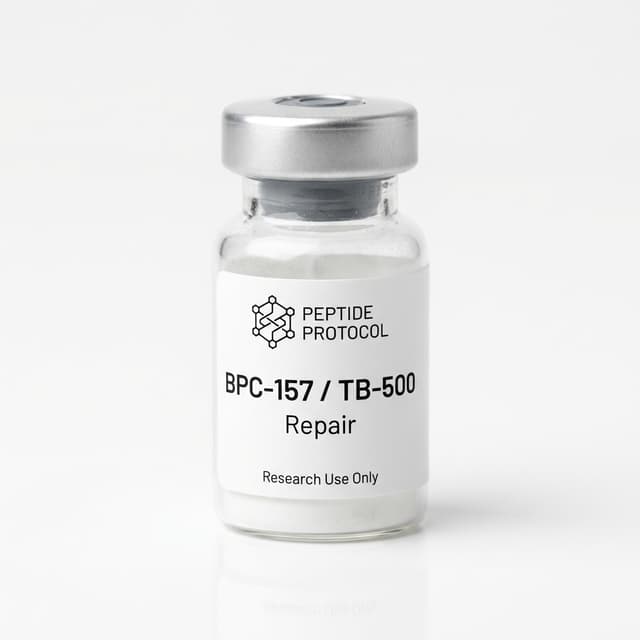
BPC-157 / TB-500
Quick Reference
- Default Dose
- 500 mcg
- Frequency
- Daily
- Timing
- AM
- Dilution
- 2 ml
For Practitioners
Interested in offering research-grade compounds through your practice? Learn about our affiliate program for qualified practitioners.
Find a ProviderPractitioner Information