
Lipolysis fragment of HGH
Precision Fat Loss—No Hormone Trade-Offs
Research Background
AOD-9604 is a synthetic peptide derived from the fat-metabolism region of human growth hormone, specifically the 176–191 amino acid sequence. It was engineered to replicate HGH’s fat-burning properties while avoiding the hormone’s growth-promoting and insulin-altering effects. The peptide was developed as an anti-obesity therapeutic, targeting the metabolic signaling that controls fat storage and fat breakdown without stimulating systemic growth hormone activity. In practical terms: HGH → growth, IGF-1, metabolism AOD-9604 → targeted fat metabolism Development History AOD-9604 originated from pharmaceutical research attempting to isolate the lipolytic portion of growth hormone. Key milestones: • Developed by Metabolic Pharmaceuticals in Australia • Based on research into the fat-regulating domain of Human Growth Hormone • Entered multiple Phase II human clinical trials for obesity treatment • Demonstrated fat-loss activity with no measurable impact on IGF-1 or glucose levels Although trials showed good safety results, commercial development slowed due to limited efficacy relative to large pharmaceutical obesity drugs. Mechanism of Action AOD-9604 works primarily at the level of adipose tissue (fat cells). Core mechanisms: Stimulates lipolysis Promotes the breakdown of stored triglycerides in fat cells. Inhibits lipogenesis Prevents the formation of new fat stores. Activates metabolic enzymes Including pathways involving Hormone-Sensitive Lipase. Increases fatty acid mobilization Fatty acids are released from adipocytes and used as fuel. Unlike HGH: • Does not significantly activate GH receptors • Does not increase IGF-1 levels • Does not stimulate tissue growth
| Level | Dose | Frequency | Notes |
|---|---|---|---|
| Beginner | 0.5 mg | Daily | AM |
| Intermediate | 1 mg | Daily | — |
| Advanced | 1.5 mg | Daily | Split AM & PM |
| Maximum | 2 mg | Daily | Split AM & PM |
Pharmacodynamics
AOD-9604 exerts its lipolytic effects through selective activation of beta-3 adrenergic receptors, primarily located in adipose tissue. Unlike full-length growth hormone, this 16-amino acid fragment (corresponding to HGH positions 176-191) demonstrates preferential binding to these receptors without significantly activating growth hormone receptors or stimulating IGF-1 production. Upon beta-3 adrenergic receptor activation, AOD-9604 initiates a cascade involving adenylyl cyclase activation and increased cyclic adenosine monophosphate (cAMP) levels. This leads to protein kinase A (PKA) activation, which phosphorylates and activates hormone-sensitive lipase (HSL), the rate-limiting enzyme in lipolysis. Additionally, AOD-9604 appears to activate AMP-activated protein kinase (AMPK) pathways, though the exact mechanism remains under investigation. AMPK activation promotes fatty acid oxidation while simultaneously inhibiting acetyl-CoA carboxylase (ACC), thereby reducing fatty acid synthesis and lipogenesis. The peptide demonstrates tissue selectivity, showing preferential effects on visceral and subcutaneous adipose tissue while having minimal impact on muscle tissue growth or glucose metabolism. Time-course studies suggest peak lipolytic activity occurs within 2-4 hours post-administration, with effects sustained for 6-8 hours. Importantly, AOD-9604 maintains the fat-mobilizing properties of growth hormone while avoiding the anabolic effects that could lead to unwanted muscle growth or metabolic disruption, making it an attractive candidate for targeted fat loss applications.
Pharmacokinetics
AOD-9604 is typically administered via subcutaneous injection due to its peptide nature and susceptibility to gastrointestinal degradation. Following subcutaneous administration, the peptide demonstrates relatively rapid absorption with peak plasma concentrations achieved within 30-60 minutes. The bioavailability appears favorable through this route, though exact percentages require further clinical validation. Distribution studies suggest AOD-9604 has good tissue penetration, particularly to adipose tissue where its primary targets are located. Protein binding characteristics remain incompletely characterized, though preliminary data suggest moderate binding to plasma proteins. The peptide undergoes enzymatic degradation primarily through peptidases and proteases, with metabolism occurring in the liver and kidneys. The elimination half-life is estimated to range from 2-4 hours based on limited pharmacokinetic studies, necessitating multiple daily dosing for sustained effects. Renal excretion appears to be the primary elimination pathway for metabolized fragments, though some intact peptide may also be eliminated through this route. The relatively short half-life is consistent with other small peptides and contributes to the need for frequent dosing regimens in research protocols.
Clinical Data
Preclinical studies in animal models have demonstrated AOD-9604's ability to reduce body fat accumulation and promote fat oxidation without significant effects on lean body mass or glucose homeostasis. Early rodent studies showed dose-dependent reductions in adipose tissue mass and improvements in metabolic parameters. Limited human clinical data exists, with small-scale studies suggesting potential efficacy for body fat reduction, though comprehensive Phase II/III trials are lacking. Available human studies have generally reported good tolerability profiles, with most adverse events being mild and transient, including injection site reactions, mild fatigue, and occasional headaches. Currently, AOD-9604 remains investigational and is not approved by major regulatory agencies such as the FDA or EMA for therapeutic use. The World Anti-Doping Agency (WADA) has classified it as a prohibited substance due to its growth hormone-related properties. Research continues to focus on optimizing dosing regimens, understanding long-term safety profiles, and establishing efficacy in larger patient populations. Future studies are exploring potential applications in metabolic syndrome, obesity management, and age-related body composition changes. The peptide's unique selectivity for lipolytic pathways without significant anabolic effects continues to generate interest in the metabolic research community.
References
- The lipolytic fragment of human growth hormone is more effective than the intact hormone in stimulating lipolysis in human adipose tissue — Heffernan MA et al., Journal of Endocrinology (2001)
- AOD9604, a lipolytic fragment of human growth hormone, does not affect glucose homeostasis in obese/diabetic mice — Ng FM et al., Journal of Molecular Endocrinology (2000)
- Growth hormone and lipolysis: recent advances — Moller N et al., Current Opinion in Endocrinology, Diabetes and Obesity (2009)
Research Use Only: All compounds discussed on this page are intended for laboratory research purposes only. Not for human consumption. All research should be conducted in compliance with institutional guidelines and applicable regulations. Consult qualified healthcare professionals before making any decisions regarding compound research or use.
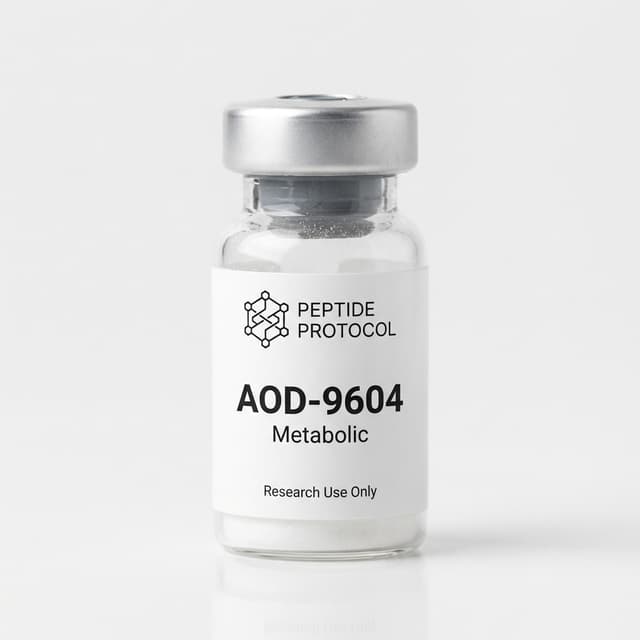
AOD-9604
Quick Reference
- Default Dose
- 0.5 mg
- Frequency
- Daily
- Timing
- AM/Pre-workout
- Dilution
- 1 mL
Storage
- Lyophilized
- -20°C
- Reconstituted
- 2-8°C
For Practitioners
Interested in offering research-grade compounds through your practice? Learn about our affiliate program for qualified practitioners.
Find a ProviderPractitioner Information