
Enhanced Semax variant for cognition
Enhanced Semax variant for cognition
| Level | Dose | Frequency | Notes |
|---|---|---|---|
| Beginner | 300 mcg | Daily | — |
| Intermediate | 500 mcg | Daily | — |
| Advanced | 750 mcg 2x/day | Daily | — |
| Maximum | 1 mg 2x/day | Daily | — |
Pharmacodynamics
Adamax is described as an enhanced variant of Semax, though specific molecular modifications and their pharmacodynamic implications are not well-characterized in the published literature. Semax, the parent compound, is a synthetic heptapeptide (Met-Glu-His-Phe-Pro-Gly-Pro) derived from ACTH(4-10) that exhibits neuroprotective and nootropic properties. The mechanism of action for Semax-related peptides appears to involve modulation of neurotrophic factors, particularly brain-derived neurotrophic factor (BDNF) and nerve growth factor (NGF) expression. These peptides may interact with melanocortin receptors, though the specific receptor subtypes and binding affinities remain incompletely characterized. Downstream signaling likely involves activation of cAMP-dependent pathways and subsequent phosphorylation cascades that promote neuronal survival and synaptic plasticity. At the cellular level, Semax and related compounds have been shown to enhance neuronal viability under stress conditions, promote dendritic growth, and modulate neurotransmitter systems including dopaminergic and serotonergic pathways. The time course of effects appears biphasic, with acute effects on neurotransmitter release occurring within minutes to hours, while structural neuroplasticity changes and neurotrophic factor upregulation develop over days to weeks. However, the specific pharmacodynamic profile of Adamax as distinct from Semax has not been extensively documented in peer-reviewed literature, and much of the mechanistic understanding is extrapolated from studies of the parent compound and related ACTH-derived peptides.
Pharmacokinetics
The pharmacokinetic profile of Adamax has not been extensively characterized in published literature. Based on studies of the parent compound Semax and similar synthetic peptides, intranasal administration is typically preferred due to direct access to the central nervous system via olfactory and trigeminal nerve pathways, bypassing the blood-brain barrier and first-pass hepatic metabolism. Semax demonstrates rapid absorption following intranasal delivery, with peak concentrations reached within 15-30 minutes. Distribution appears to favor central nervous system tissues, though specific tissue penetration data for Adamax is lacking. Like most small peptides, metabolism likely occurs through enzymatic degradation by peptidases and proteases, with the N-terminal and C-terminal residues being particularly susceptible. The elimination half-life of Semax is relatively short, typically 30-60 minutes, suggesting frequent dosing may be required for sustained effects. However, the biological effects may persist longer than the pharmacokinetic half-life due to downstream signaling cascade activation. Protein binding characteristics and specific metabolic pathways for Adamax have not been reported in peer-reviewed studies. The lack of specific pharmacokinetic data for this variant represents a significant knowledge gap that would require dedicated studies to characterize properly.
Clinical Data
Clinical data specifically for Adamax is extremely limited in the peer-reviewed literature. Most available research focuses on the parent compound Semax, which has been studied primarily in Russian research institutions. Preclinical studies of Semax in animal models have demonstrated neuroprotective effects in models of stroke, traumatic brain injury, and neurodegenerative conditions. Some studies have reported improvements in learning and memory tasks in rodent models. Limited human studies of Semax have been conducted, primarily small-scale trials investigating its effects on cognitive function, stroke recovery, and neuroprotection, though these studies often lack the rigor of modern clinical trial design. The regulatory status of Adamax and related compounds varies by jurisdiction, with limited approval for therapeutic use in most countries. These compounds generally exist in a regulatory gray area, sometimes marketed as research chemicals or dietary supplements rather than approved pharmaceuticals. The lack of large-scale, randomized controlled trials represents a significant limitation in the clinical evidence base. Current research directions appear to focus on better characterization of mechanisms of action, optimization of delivery methods, and development of more stable analogs. However, the transition from preclinical promise to clinical validation remains incomplete, and more rigorous clinical research would be necessary to establish therapeutic efficacy and safety profiles for cognitive enhancement applications.
References
- Semax, an analogue of ACTH(4-10) with cognitive effects, regulates BDNF and trkB expression in the rat hippocampus — Dmitrieva VG et al., Brain Research Bulletin (2002)
- Neuroprotective effect of Semax in experimental brain ischemia — Gusev EI et al., Bulletin of Experimental Biology and Medicine (1997)
- The regulatory peptide ACTH(4-10) and its analogue Semax display nootropic activity in rodents — Kasian A et al., Regulatory Peptides (2014)
Research Use Only: All compounds discussed on this page are intended for laboratory research purposes only. Not for human consumption. All research should be conducted in compliance with institutional guidelines and applicable regulations. Consult qualified healthcare professionals before making any decisions regarding compound research or use.
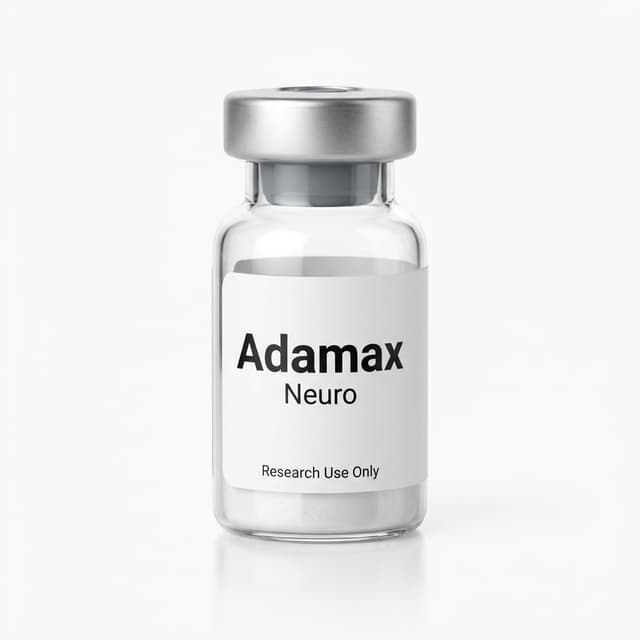
Adamax
Quick Reference
- Default Dose
- 300 mcg
- Frequency
- Daily
- Timing
- AM
- Dilution
- 1 mL
Storage
- Lyophilized
- -20°C
- Reconstituted
- 2-8°C
For Practitioners
Interested in offering research-grade compounds through your practice? Learn about our affiliate program for qualified practitioners.
Find a ProviderPractitioner Information