99%+ Purity
COA Included
Sealed Vials
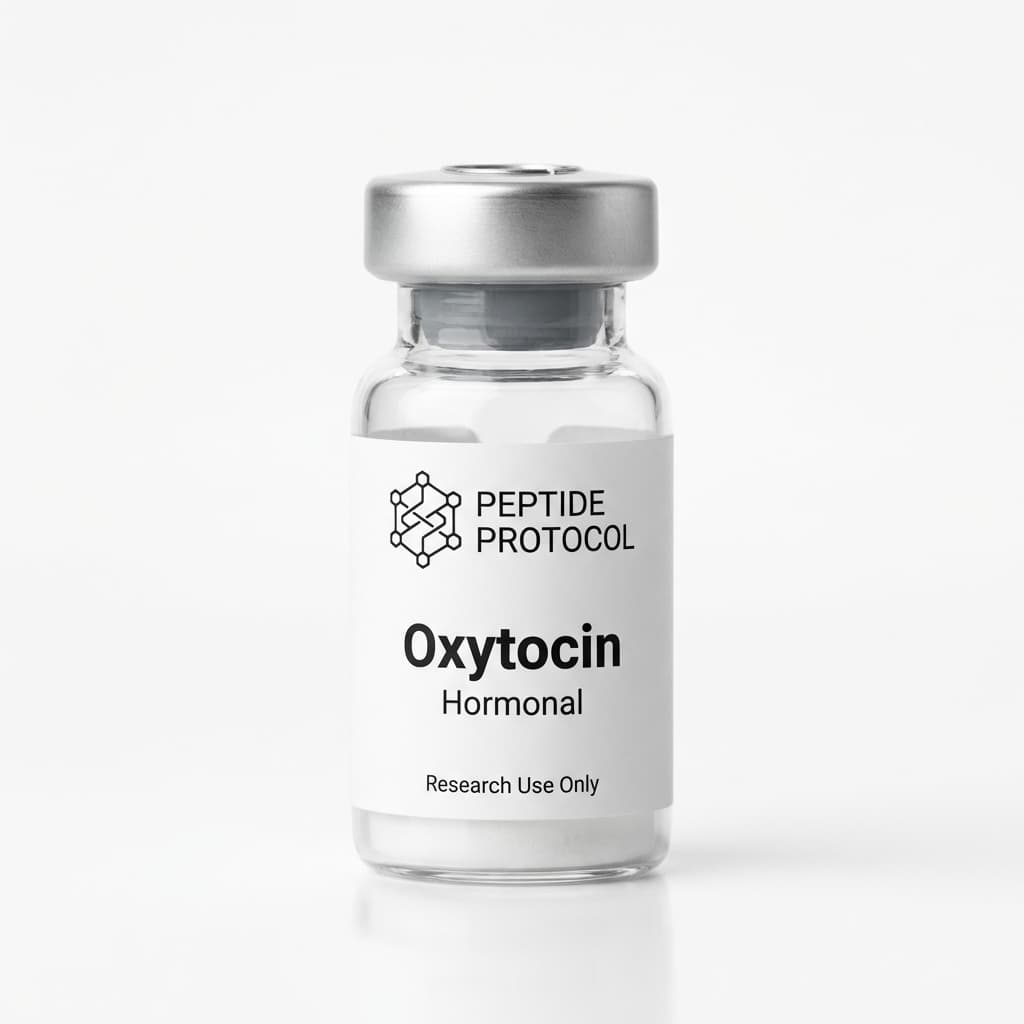
Oxytocin
Bonding hormone for social connection
Bonding/libido
Key Benefits
- May enhance interpersonal trust and empathy
- Supports natural pair bonding mechanisms
- Promotes social cognition and connection
- May benefit sexual arousal responses
- Reduces stress during social interactions
- Supports reward pathway neurotransmitter activity
- May facilitate intimate relationship formation
Want to purchase this peptide?
Turn Off Social Anxiety, Turn On Real Connection
Most people struggle with trust and intimacy not because they lack social skills, but because their neurochemistry works against them. Oxytocin changes that fundamental equation by directly targeting the brain circuits that govern bonding, empathy, and sexual connection. You get the social confidence and intimate relationships that feel natural instead of forced.
Oxytocin receptor signaling / Social bonding and reward pathway modulation
About Oxytocin
Oxytocin is the body's primary bonding hormone, naturally released during intimate moments and social connection. This peptide works by binding to specific receptors in brain regions that control trust, empathy, and sexual arousal, essentially rewiring your neurochemistry for deeper relationships. It reduces the stress response during social interactions while enhancing your ability to form meaningful connections.
Who It's For
This is for individuals who want to enhance their capacity for intimate relationships, whether romantic or social, without relying on external confidence boosters. Oxytocin works best as part of comprehensive relationship and personal development protocols, particularly for those who struggle with trust, social anxiety, or sexual connection issues that stem from neurochemical rather than psychological barriers.
Research Background
Oxytocin, often called the "love hormone," is a naturally occurring neuropeptide that plays crucial roles in social bonding, trust, and intimate relationships. The peptide works primarily through the oxytocin receptor system in the brain, particularly in regions associated with reward, emotion, and social behavior. When oxytocin binds to its receptors, it triggers cascades that influence neurotransmitter release, ultimately promoting feelings of attachment and reducing stress responses during social interactions.
Current research focuses on several key areas: (1) optimizing delivery methods to ensure the peptide reaches brain targets effectively, (2) understanding individual differences in response based on genetics and personality factors, and (3) developing therapeutic applications for conditions involving social difficulties. While animal studies have consistently shown oxytocin's role in pair bonding and sexual behavior, human studies present a more complex picture, with effects varying significantly between individuals and contexts. The field continues to evolve as researchers work to bridge the gap between promising preclinical findings and reliable clinical applications for enhancing human bonding and intimacy.
Dosing Protocol
| Level | Dose | |
|---|---|---|
Beginner | 10 IU | |
Intermediate | 20 IU | |
Advanced | 20-40 IU | |
Maximum | 50-60 IU |
Select a dosing level and click Calculate to plan your protocol.
Vials Required
72
720.0 IU needed ÷ 10 per vial
Total Investment
$2160
$30.00 per vial
Per Dose
2.00 mL
200 units on U-100 syringe
Doses per Vial
0
10 ÷ 20.00 IU/dose
* Calculations based on standard reconstitution protocols. Consult research guidelines for specific applications.
Educational Resources
Download educational materials and research documentation for Oxytocin.
Oxytocin Cheat Sheet
Dosing protocols, reconstitution & storage guide
Featured in These Stacks
Athena Protocol
Female Recomp
Athena is a systems-based female recomp architecture designed to build lean muscle, reduce visceral fat, and preserve hormonal stability without creating endocrine chaos. It is built on a simple premise: women do not respond optimally to metabolic aggression. They respond to precision, rhythm, and signal alignment. Instead of pushing harder — cutting calories deeper, adding excessive cardio, or layering stimulants — Athena recalibrates the internal environment so fat loss and muscle development can coexist. The first and most critical layer is insulin sensitivity. Insulin is the metabolic command center. If it is unstable, nothing downstream performs correctly — not thyroid, not cortisol, not fat oxidation. Retatrutide-class signaling forms the metabolic reset by regulating appetite at the brain level, improving nutrient partitioning, and increasing energy expenditure. This reduces visceral fat bias while preserving lean mass. Supporting glucose handling further through agents like Berberine- or Metformin-class tools enhances cellular fuel traffic, preventing repeated insulin spikes that drive storage. Resistance training anchors this layer, as muscle — particularly the glutes — is the most powerful insulin sensitizer available. This is not about eating less; it is about partitioning better. Once insulin is stabilized, Athena upgrades mitochondrial efficiency. The MITOMAX™ layer (SS-31, MOTS-C, 5-Amino-1MQ) enhances cellular energy production and fat oxidation signaling without stimulant-driven stress. SS-31 improves mitochondrial membrane stability, MOTS-C enhances metabolic flexibility through AMPK-related pathways, and 5-Amino-1MQ reduces metabolic inefficiency associated with fat storage. This layer allows stored fuel to become usable energy. The result is higher output at lower hormonal cost — true engine tuning. Structural strength is then reinforced through resistance training combined with GH-axis support. PM Tesamorelin or Ipamorelin enhances natural nocturnal growth hormone rhythm, improving recovery, fat partitioning, and lean mass retention. Conservative AM Ipamorelin provides mild anabolic tone without overstimulation. This balances the stress-to-recovery ratio — a critical factor in female physiology. When recovery exceeds stress, recomp progresses smoothly. Sleep architecture is protected with DSIP, reinforcing deep sleep and parasympathetic tone. Female metabolism is rhythm-dependent; even minor sleep disruption elevates cortisol and reduces thyroid conversion. By stabilizing sleep, Athena protects hormonal tempo. Cortisol regulation is further supported through Oxytocin and Cortagen, which reduce perceived stress signaling and improve HPA resilience. Female physiology is highly responsive to safety signals — calm is metabolic. Thyroid tempo is preserved through Pinealon, which supports hypothalamic coordination. Rather than forcing output, Athena protects upstream rhythm so metabolic rate remains intact during recomposition. Epitalon reinforces circadian alignment and longevity signaling, ensuring the system remains resilient long-term. KLOW (TB-4, BPC-157, KPV, GHK-Cu) supports connective tissue, collagen integrity, and inflammation balance, allowing consistent training without structural breakdown. Optional aesthetic and vitality layers — MT1 or MT2 for tanning and PT-141 for libido signaling — enhance confidence and presence without disrupting metabolic stability. These are polish layers, not foundations. In essence, Athena is not a crash protocol. It is a calibrated performance architecture. Stabilize insulin. Upgrade mitochondrial efficiency. Build muscle strategically. Protect sleep, cortisol rhythm, and thyroid tempo. Layer longevity and aesthetic refinement only after the core system is stable. The outcome is athletic, composed, metabolically efficient strength — without hormonal fragility. Precision > horsepower.
Includes
Compliance & Disclaimer
This product is intended for laboratory research purposes only. Not for human consumption. All products are sold with the understanding that the purchaser will comply with all applicable local, state, and federal laws regarding the purchase and use of research chemicals. Certificate of Analysis available upon request.